SaaS CAC Keeps Rising? Here’s Exactly Why and How to Fix It

Quick Wins — Key Takeaways
- Rising CAC isn’t a budget problem. It’s a systems problem. Spending more won’t fix it.
- There are 5 real reasons CAC keeps climbing — and every single one is fixable.
- Most teams discover problems weeks too late. Real-time AI catches them in hours.
- Adding a lead qualification layer is the most underrated CAC fix most SaaS teams skip.
- You don’t need a bigger budget. You need a smarter system.
Sound Familiar? You Spent More. CAC Went Up Anyway.
You increased the ad budget. More leads came in. And somehow… your cost to acquire a customer went up. Again.
If that’s happened to you, you’re not alone. Most SaaS companies see their CAC creep up 15–25% every year. And the scary part? Most teams respond by spending more money — which just makes the problem worse.
Here’s the truth nobody tells you: spending more isn’t the fix. The leak is in your system — not your budget.
The real solution is building a smarter acquisition engine. One that uses an AI campaign manager to find and fix inefficiencies before they drain your budget — not after. In this guide, we break down the 5 reasons CAC keeps rising, what to do about each one, and how to build a system that actually keeps acquisition costs under control.
First Things First — What Even Is CAC Escalation?
CAC stands for Customer Acquisition Cost. The formula is simple:
Formula: CAC = Total sales + marketing spend ÷ number of new customers
But here’s where most teams mess up: they look at blended CAC — total spend divided by total customers — and think everything’s fine. It’s not. Blended numbers hide what’s actually broken.
You could have one channel eating 60% of your budget and delivering almost nothing — and your blended CAC would still look “okay” because other channels are compensating. That’s how waste hides in plain sight.
There’s also a big difference between a CAC spike (which is normal — launches happen, markets shift) and CAC escalation, which is when CAC keeps climbing every single quarter for no obvious reason. That’s the dangerous one. That’s the one this guide is about.
Real talk: The question isn’t “why did CAC go up this month?” The right question is “why does CAC keep going up every month?”
The 5 Real Reasons Your CAC Keeps Climbing
CAC doesn’t just rise randomly. There’s always a reason. Usually one of these five.
Reason 1 — You’re Targeting the Wrong People (And Don’t Know It Yet)
The audience that worked brilliantly at $10K/month often falls apart at $100K/month. As you scale, ad platforms start reaching further and further from your ideal customer. Lookalike audiences get diluted. Broad targeting kicks in.
You’re still getting clicks. But the people clicking aren’t converting. Your cost-per-click looks fine. Your sales team is quietly overwhelmed with bad leads.
Real talk: More reach doesn’t mean better reach. Audience drift is silent and expensive.
Reason 2 — Your Leads Look Great. Most of Them Aren’t.
Lead numbers are up. Marketing is celebrating. Sales is frustrated. Sound familiar?
Volume and quality are very different things. When ads target too broadly, you pull in people who were never going to buy — low-intent browsers, wrong job titles, irrelevant geographies, and sometimes outright fake leads. They inflate your numbers and tank your conversion rates.
And here’s the kicker: your CAC calculation includes all of them. So even though only a fraction of your leads were ever real, you’re paying acquisition costs as if every lead was a genuine prospect.
Reason 3 — Your Ads Are Getting Stale (Faster Than You Think)
An ad that’s crushing it in month one will often be invisible by month three. People have seen it. They scroll past it. CTR quietly drops from 4% to 1.5% while you’re focused on other things.
This is creative fatigue, and it hits faster in 2026 than ever before. Meta’s delivery is so efficient now that your audience gets saturated much more quickly. And because the decline is gradual, most teams don’t catch it until the numbers have already tanked.
Reason 4 — Your Budget Is Going to the Wrong Places
More budget doesn’t automatically mean better results. If the underlying structure is inefficient, you’re just scaling the problem.
Most manually managed accounts over-invest in broad awareness campaigns — top of funnel, cold audiences, brand reach — and under-invest in the retargeting and lead gen campaigns where intent is actually proven. You’re spending the most where conversion is least likely.
Reason 5 — You Find Out About Problems Too Late
This might be the biggest one. Weekly reports. Monthly reviews. By the time someone flags a problem, that campaign has been bleeding budget for days or weeks.
A campaign running at 2× your target CPA for three weeks isn’t a small issue. It’s a significant, preventable loss. And if your only visibility comes from scheduled reports, you’re always reacting to damage that’s already done.
How to Actually Fix It — Build a CAC Control System
Here’s the mindset shift that changes everything: stop thinking of your ad account as just an ad account. Start thinking of it as a CAC control system — a machine that continuously monitors, adjusts, and improves your acquisition efficiency.
Here’s how to build it:
Fix 1 — Optimise First. Scale Second.
This sounds obvious. Almost nobody does it. Before you increase budget, get clear on which channels, audiences, and creatives are actually efficient. Then scale those. Putting more money into a broken structure just creates more waste, faster.
Fix 2 — Get Precise With Targeting. Then Keep Refining It.
Use structured audience targeting — interests, job roles, behaviours, locations. And don’t just set it and forget it. Look at downstream results. What percentage of clicks became qualified leads? What became customers? Let real conversion data drive targeting decisions, not just clicks.
Fix 3 — Catch Problems Before They Cost You
This is where AI changes the game. An AI-powered ad campaigns intelligence system monitors your campaigns 24/7 — watching for audience drift, creative fatigue, spend anomalies, and engagement drops. When something goes wrong, it flags the issue immediately and tells you exactly what to fix.
💡 Think about it this way: Would you rather find out a campaign wasted $10K last week— or prevent it from happening in the first place? That’s the difference real-time AI detection makes.
Fix 4 — Stop Paying for Bad Leads
This is the most underrated fix in SaaS, and it’s shockingly simple: add a qualification layer between your ad and your CRM.
An AI-powered chatbot screens every lead before it enters your pipeline. Hot leads go straight to sales. Warm leads get nurtured. Cold and fake leads get filtered out entirely. Your sales team works smaller numbers with much higher conversion rates — and your real CAC drops significantly.
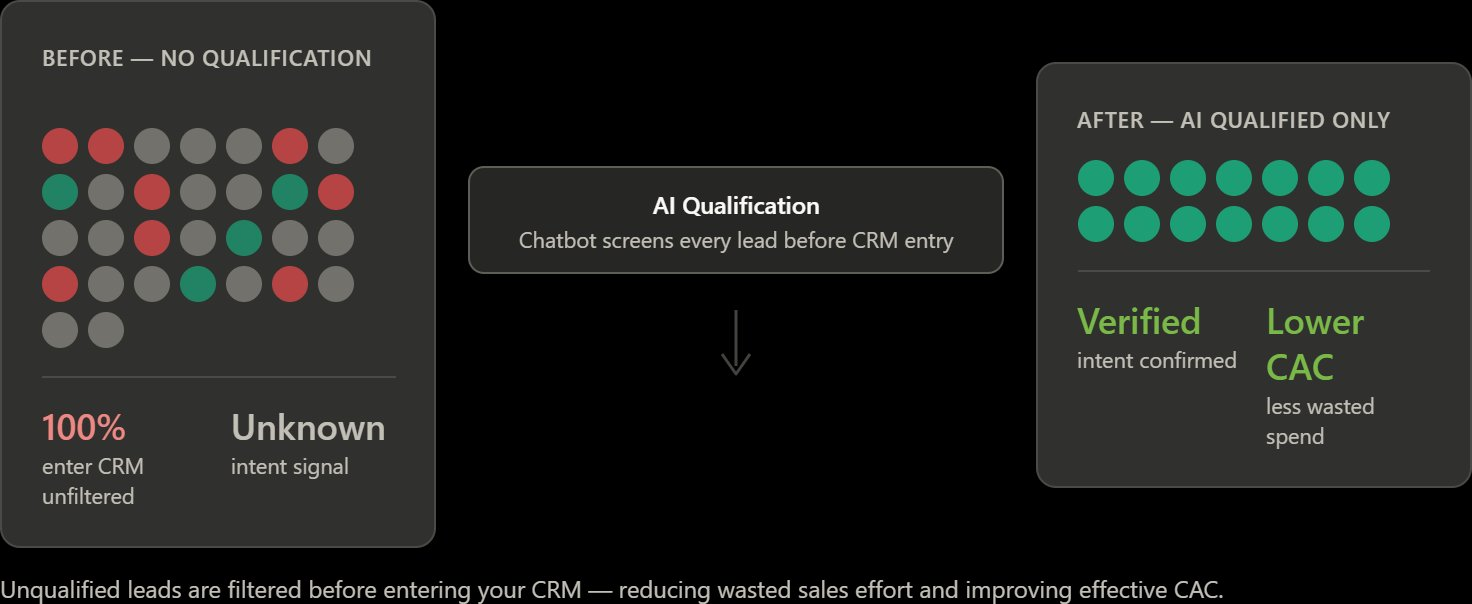
What changes when you add AI lead qualification: 100% of leads used to enter the CRM unfiltered. Now only verified, high-intent leads get through — less noise, lower effective CAC.
Fix 5 — Put Your Budget Where Conversions Actually Happen
Most accounts spend too much at the top of the funnel where people are cold, and too little at the bottom where people are ready to buy. AI flips this automatically.
It analyses where conversions are actually coming from and shifts budget toward retargeting and lead gen — the stages where your audience already knows you and is more likely to convert. Same total spend. Dramatically better results.
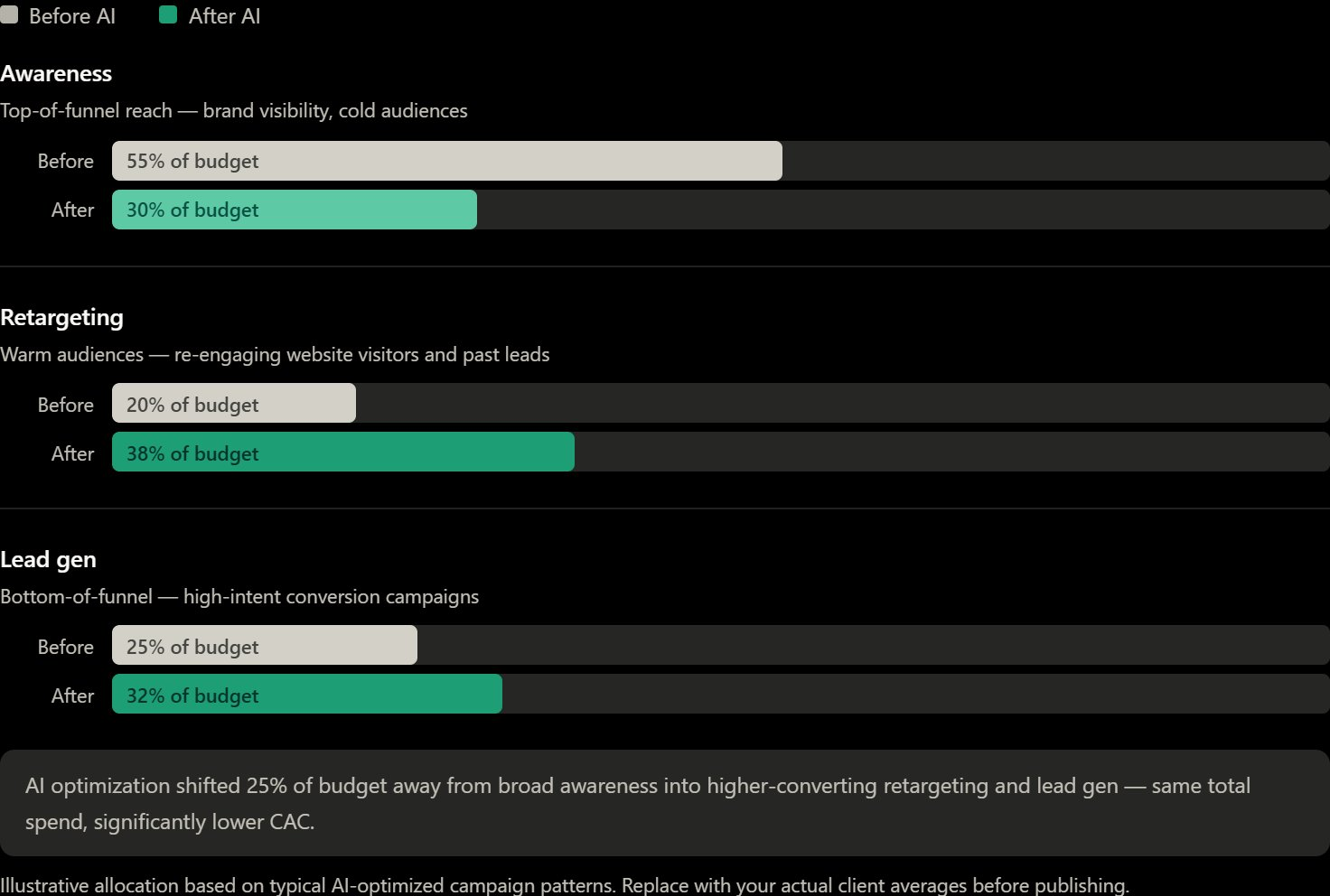
Real budget shift after AI optimisation: 25% of spend moved from broad awareness to high-converting retargeting and lead gen. Same total budget — significantly lower CAC.
Fix 6 — Make Optimisation Continuous, Not Monthly
A campaign you set up in January shouldn’t be running the same way in March. Markets change. Audiences shift. Creatives age. The best-performing acquisition systems are ones that adjust continuously — not ones that get reviewed when someone has time.
Track the full chain: impressions → clicks → qualified leads → pipeline → revenue. Fix what breaks as soon as it breaks. That’s how you turn an ad account into a compounding growth engine.
Without AI vs. With AI — Side by Side
Here’s what the same SaaS company looks like scaling from $1M to $3M ARR — once without AI, once with it.
✅ The bottom line: Teams using real-time AI catch performance problems in hours instead of weeks. That speed difference alone translates directly into lower CAC and less wasted spend.
Not Sure Where to Start? Use This 5-Step CAC Audit
Go through these five questions right now. Each one will point you toward a specific leak in your acquisition system.
- Break down your CAC by channel. Don’t look at the blended number. Look at paid social, paid search, content, and outbound separately. Which one’s actually broken?
- Check what happens to your leads after the click. What percentage actually become SQLs? If it’s below 15–20%, you have a lead quality problem — not a volume problem.
- Look at how old your best-performing ad is. If it’s been running for more than 60 days without a refresh, creative fatigue is already eating your results.
- Map where your budget goes vs. where conversions come from. The gap between those two things is your waste. That’s where to start cutting and reallocating.
- Ask: how quickly do we know when something breaks? If the answer is “next Monday’s report” — that’s your biggest problem. You need real-time visibility.
The Bottom Line: CAC Tells You How Healthy Your Acquisition System Is
When CAC keeps rising, it’s not bad luck. It’s your system telling you something is broken. The good news: every root cause we covered is diagnosable and fixable.
You don’t need a bigger budget. You need better visibility, smarter targeting, cleaner leads, and a system that catches problems fast enough to actually do something about them.
The SaaS companies winning on acquisition right now aren’t the ones spending the most. They’re the ones running the smartest systems — with real-time AI doing the heavy lifting so their teams can focus on growth instead of firefighting.
💭 Final thought: CAC is just a number. But what it reflects is your entire acquisition operation. Fix the operation, and the number fixes itself.
Frequently Asked Questions
What’s a good CAC for a SaaS company?
A good CAC for a SaaS company refers to a cost of acquiring customers that is sustainable and profitable. The ideal benchmark depends on growth stage and model.
Key benchmarks:
LTV:CAC ratio of 3:1 or higher
Payback period under 12 months
According to 2025 SaaS benchmarks, efficient companies maintain CAC trends that stay stable or decline over time.
Why does my Facebook or Google ad CAC keep going up?
Rising CAC in Facebook or Google ads refers to increasing customer acquisition costs due to performance inefficiencies. This usually signals hidden issues.
Common causes:
Targeting drift
Creative fatigue
Low-quality leads
Poor budget allocation
Studies show fixing these issues can reduce CAC by 20–40%.
How does AI help bring down CAC?
AI reducing CAC refers to using automation and data analysis to lower customer acquisition costs efficiently. It improves performance in real time.
How AI helps:
Detects issues instantly
Optimizes targeting and spend
Filters low-quality leads
According to 2025 marketing reports, AI-driven campaigns reduce CAC by up to 30%.
Can I reduce CAC without spending less on ads?
Reducing CAC without lowering ad spend refers to improving efficiency within the same budget. Better systems drive better results.
How to reduce CAC:
Improve lead quality
Refine targeting
Refresh creatives
Reallocate budget
Case studies show optimized campaigns can improve efficiency by 2–3x.
What metrics should I actually track to control CAC?
CAC tracking metrics refer to the key data points that influence customer acquisition cost across the funnel. Tracking the right metrics is critical.
Important metrics:
Qualified leads and SQL rate
CTR and engagement trends
Cost per qualified lead
Conversion to revenue
According to analytics studies, full-funnel tracking improves CAC control by over 35%.