
Stop Wasting Traffic: The 3-Step AI Conversion System That Actually Works

You're spending real money driving traffic to your Meta ads. Landing page views are climbing. But sales? Flat. Leads? Nowhere. Here's the hard truth most brands never hear: you don't have a traffic problem — you have a conversion problem. And throwing more budget at traffic won't fix it. The solution is a smarter system — one that tracks, retargets, and converts the visitors you're already paying for.
Why Traffic Alone Is Not Enough — The Conversion Gap Most Brands Ignore
Most performance marketers are trained to celebrate the wrong metrics. Low cost-per-click. High landing page views. Impressive reach numbers. But here's what those numbers don't show: what happened after the click.
In real Meta ad accounts, we consistently see the same pattern — high traffic volume paired with near-zero qualified leads. Visitors arrive, bounce, and disappear. No tracking. No follow-up. No second chance to convert them. Every untracked visitor is wasted ad spend.
CLIENT CASE STUDY · OCT 16–26
2,367 landing page views. ₹4,174 spent. Leads = 0.
Where did all that traffic go? Without a tracking and retargeting system, most of it simply leaked away.
Real client data · Same ₹4,174 budget · The only difference is the conversion system
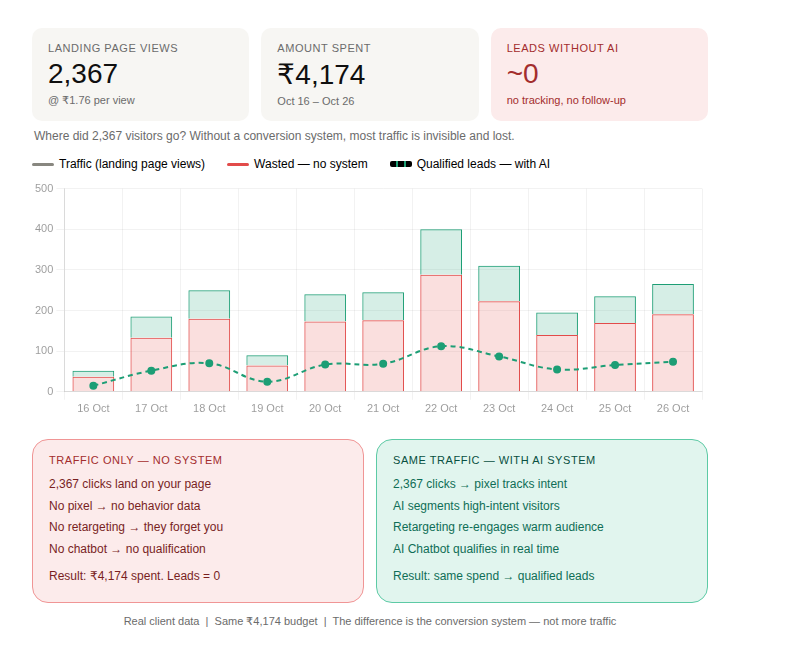
The conversion gap is real. And it's not a creative problem or an audience problem. It's a systems problem — the infrastructure between the ad click and the qualified lead is missing.
"Conversion happens after the click — on your website, through behavior tracking, intent detection, and smart follow-ups. Traffic is just the entry point."
Step 1: Track Audience Traffic Properly with Meta Pixel + AI Campaign Manager
Most brands install Meta Pixel and stop there. Page view tracked. Job done. But that's barely scratching the surface of what intelligent tracking can do — and it's the foundation everything else depends on.
A true AI campaign manager integrates deeply with Meta Pixel to move beyond basic click tracking. Instead of knowing someone visited your page, you know how they visited it — what they read, how long they stayed, what they scrolled past, and what intent signals they left behind.
What intelligent pixel tracking captures
- Page views and session depth — not just that someone arrived, but how far they went
- Time spent on site — a visitor spending 90 seconds on your pricing page is not the same as a 3-second bounce
- Scroll depth and button interactions — did they reach your CTA? Did they hover over your contact form?
- Custom intent events — video plays, chatbot initiations, form field touches
- Cross-session behavior — tracking returning visitors across multiple touchpoints
With this data, Meta ads automation becomes genuinely intelligent. You stop funding broad audiences based on demographics and start allocating budget toward people who've already shown real purchase intent — but haven't converted yet.
Step 2: Smart Retargeting Based on Real Audience Intent
Basic retargeting says: "Show this ad to everyone who visited the website." Intelligent, behavior-based retargeting says: "Show this specific ad to people who spent 90+ seconds on the product page, scrolled past the pricing section, and didn't fill out the form."
That's not a small difference in approach. It's a fundamental upgrade in conversion efficiency — and it's exactly what AI ad optimization enables at scale.
How behavior-based audience segmentation works
This segmentation is what allows you to run Meta ads on autopilot without wasting budget on cold, uninterested visitors. Your spend concentrates on people who've already demonstrated genuine interest — and your cost per qualified lead drops dramatically as a result.
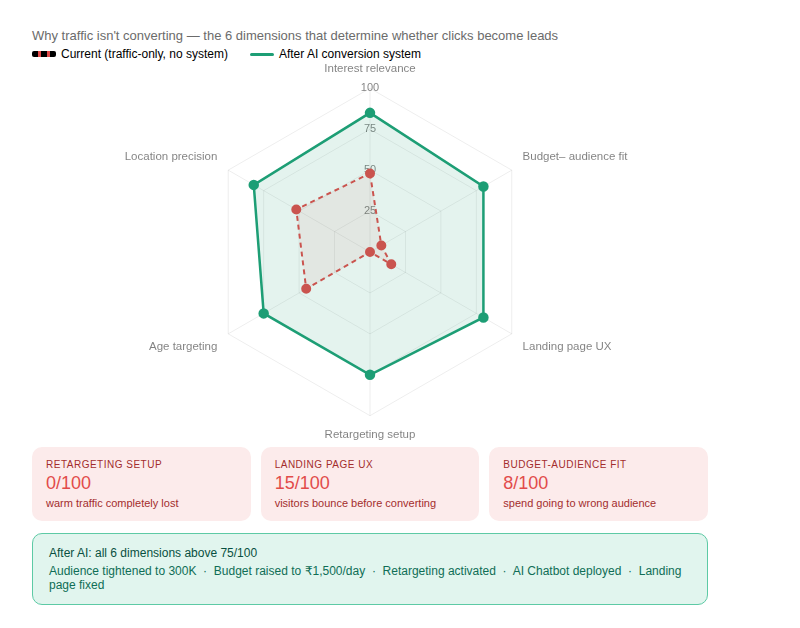
The data below shows what happens when you audit the full conversion health of a real account — and what changes after activating an AI-powered system. The before-state is what most Meta advertisers are silently living with.
CONVERSION HEALTH AUDIT · BEFORE VS. AFTER AI
Why traffic isn't converting — 6 dimensions that determine whether clicks become leads
Same client. Same audience. Dramatically different outcomes once the full conversion system was activated.
Real client audit data · Retargeting score: 0 → 75 · Budget-audience fit: 8 → 80
Step 3: Intelligent Follow-Up Using AI Chatbot + Automated Funnel
Tracking tells you who's interested. Retargeting brings them back. But it's the follow-up mechanism that converts interest into a qualified lead — and this is where most brands drop the ball entirely.
An AI marketing campaigns system deploys a conversational AI chatbot on your website that does three things simultaneously: detects real-time intent, asks qualifying questions, and guides visitors down the funnel — without requiring any human involvement.
What the AI chatbot funnel looks like in practice
- A visitor arrives via your Meta ad and starts reading your service page
- After 45 seconds of engagement, the AI chatbot activates with a contextual, relevant opening
- It asks 2–3 qualifying questions to understand the visitor's need, timeline, and budget
- Based on their responses, it routes them to the right offer, booking page, or follow-up sequence
- Their behavior data is fed back into your pixel, improving future audience segmentation
- Automated follow-ups via Messenger, WhatsApp, or email continue the conversation
The result is a complete loop: cold Meta traffic flows in, gets tracked, gets retargeted, gets qualified by the chatbot, and exits as a warm, sales-ready lead — all without a human touching the process until the conversation is already deep into intent.
This is what automated lead generation with AI actually means in practice. Not just faster manual work. A genuinely autonomous conversion engine that runs 24/7 on every visitor your Meta spend delivers.
Putting It All Together: The Complete AI-Powered Conversion System
The three steps work together as a single, compounding system — not three separate tactics bolted on independently. Each layer feeds the next:
- Pixel + AI tracking captures intent data from every visitor, creating high-quality audience segments
- Behavior-based retargeting uses those segments to bring back high-intent visitors at the right moment
- AI chatbot + automated funnel converts returning visitors into qualified leads without human intervention
Together, this is how you reduce CPA with AI — not by spending less on traffic, but by converting a dramatically higher percentage of the traffic you're already paying for. An AI marketing automation platform that connects all three layers means you can improve ROAS on Meta ads without the need to constantly increase ad spend.
The strongest Meta advertisers in 2025 aren't the ones with the biggest budgets. They're the ones whose conversion infrastructure turns more of every click into a real business outcome.
Conclusion: Stop Celebrating Traffic. Start Celebrating Leads.
The traffic is already there. You're already paying for it. The question is whether your system is set up to capture it — or let it silently leak away click by click.
Real conversion results come from three connected layers working together: tracking audience behavior with intelligent pixel setup, retargeting based on genuine intent signals, and qualifying visitors automatically through a conversational AI funnel. That's what turns Meta ad spend into a predictable, scalable source of qualified leads.
You don't need more traffic. You need a better conversion system. Build it once, and every click you've already paid for starts working harder for you.
Frequently Asked Questions
Why isn't my Meta traffic converting into leads?
Most Meta traffic fails to convert because there's no system in place after the click. Without proper pixel tracking, behavior-based retargeting, and an intelligent follow-up mechanism like an AI chatbot, visitors land on your page and disappear — taking your ad budget with them. More traffic won't fix a broken conversion system.
What is behavior-based retargeting and how does it work?
Behavior-based retargeting segments your website visitors by how they actually behaved — time on site, pages visited, scroll depth, and chatbot interactions. Instead of showing the same ad to all visitors, you target high-intent users (like those spending 90+ seconds on your pricing page) with tailored conversion offers, dramatically improving your return on ad spend.
How does an AI chatbot help convert website traffic into leads?
An AI chatbot detects visitor intent in real time, triggers at the right moment based on engagement signals, and asks qualifying questions to guide users down your funnel. It handles initial qualification automatically — routing interested prospects to offers, booking pages, or follow-up sequences — turning cold traffic into warm, sales-ready leads without human involvement.
Can I get more leads from Meta ads without increasing my budget?
Yes — often significantly so. If your current traffic converts at a very low rate, improving your pixel setup, enabling behavior-based retargeting, and deploying an AI chatbot funnel can generate substantially more qualified leads from your existing spend. Our client case study showed the same ₹4,174 budget producing near-zero leads before the system, and measurable qualified leads after.
What is an AI Campaign Manager and how is it different from standard Meta ads tools?
An AI Campaign Manager goes beyond Meta's native ad tools by integrating advanced pixel tracking, AI-powered audience segmentation, automated retargeting rules, and a connected chatbot funnel into one system. It analyzes real-time conversion signals to automatically shift budget toward high-intent audiences — reducing CPA and improving ROAS without constant manual optimization.