Click-to-WhatsApp Lead Costs in India (2026)
Your cost per lead is more than the price of a Meta ad click. Learn how WhatsApp messaging charges, qualification flows and lead quality affect the real cost of acquiring a customer in India.

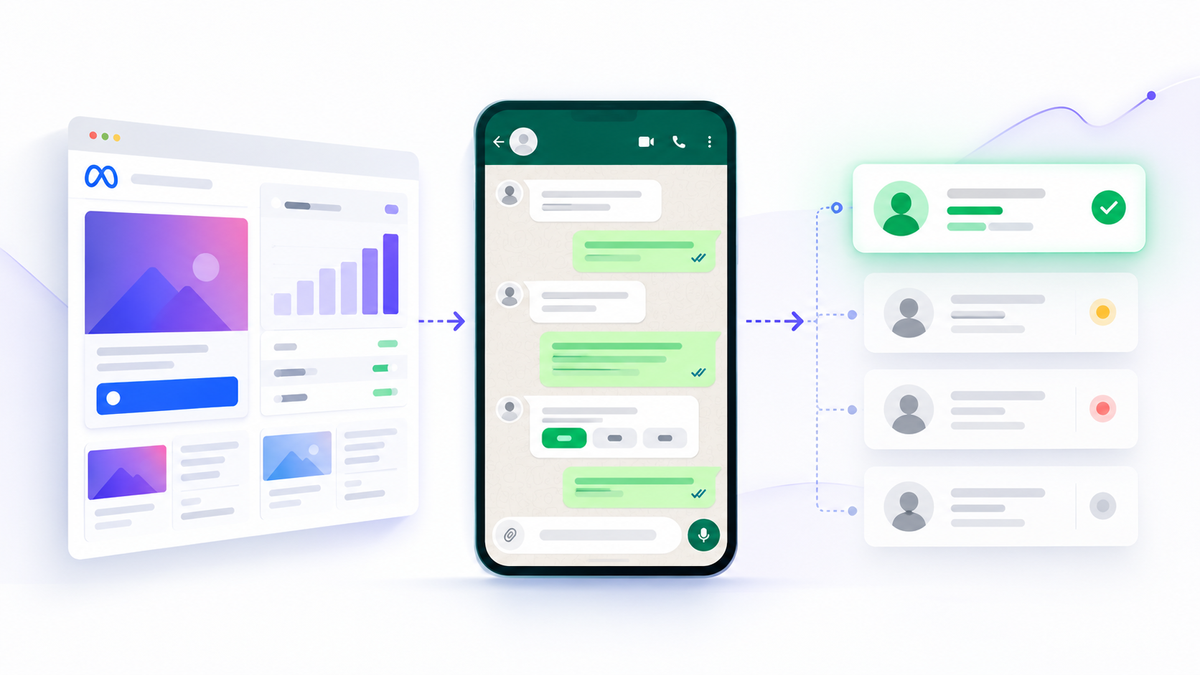
Click-to-WhatsApp Lead Qualification Cost in India (2026)
Updated: 14 October 2026
A Click-to-WhatsApp lead costs more than the price of the ad click. Your real acquisition cost includes Meta Ads spend, WhatsApp messaging, your automation or software provider, and the time your team spends qualifying leads.
There is one important detail: WhatsApp message charges and lead qualification costs are not the same thing. You can reduce the cost of qualifying a lead without necessarily reducing the price of every message.
If you run Meta Ads for clients, sell through WhatsApp, or manage performance marketing for lead-generation businesses, here is how to calculate the real cost.
Quick answer
The cost of qualifying a Click-to-WhatsApp lead depends on four variables:
- Ad spend: What you pay to generate conversations.
- WhatsApp charges: Meta's message rates, applicable free windows and allowances.
- Automation costs: Your WhatsApp Business Platform provider, chatbot or qualification software.
- Qualification efficiency: How many conversations become genuine, sales-ready leads.
For Indian recipients, the Meta rate card effective 1 October 2026 lists ₹0.8631 per delivered marketing template message and ₹0.115 per utility, authentication or service message, before applicable taxes. Service-message allowances and the 72-hour free entry-point window can change the actual bill. Always verify the rate card for your account before forecasting costs.
The important metric is not simply cost per conversation. It is cost per qualified lead.
1. What changed in WhatsApp messaging costs in October 2026?
WhatsApp Business Platform charges depend on message category, recipient market and the applicable pricing rules.
The October 2026 changes matter because older articles may still describe service replies inside the 24-hour customer-service window as free in all circumstances.
| Message category | India rate reported from 1 October 2026 | What to know |
|---|---|---|
| Marketing template | ₹0.8631 | Charged per delivered message |
| Utility template | ₹0.115 | Category and eligibility rules apply |
| Authentication | ₹0.115 | Used for verification messages |
| Service replies | ₹0.115 after the free allowance | First 1,000 eligible service messages per business phone number per month are free |
| Click-to-WhatsApp ad entry window | Meta messaging charges may be waived during the eligible 72-hour window | Eligibility and window rules apply |
These are Meta message charges, not your entire WhatsApp bill. Provider subscriptions, automation fees, additional services and applicable taxes can increase the total.
Important: A qualifying conversation initiated through a Click-to-WhatsApp ad can open a 72-hour free entry-point window. Do not apply ordinary service-message rates blindly to every reply in that window. Check Meta's current documentation and your provider's billing records.
Sources: Meta WhatsApp Business Platform pricing and WhatsApp Business Platform documentation.
2. The three costs behind every qualified lead
Cost A: Meta Ads
Suppose a campaign spends ₹30,000 and generates 600 WhatsApp conversations.
The cost per conversation is:
₹30,000 ÷ 600 = ₹50 per conversation
That is useful, but it does not tell you how many people are actually interested in buying.
Cost B: WhatsApp messaging and automation
A qualification flow might ask a prospect:
- What product or service are you interested in?
- What is your budget?
- When do you plan to buy?
- Which city or service area are you in?
- Would you like a sales representative to contact you?
The number of messages sent, their categories, whether the conversation qualifies for a free window, and your provider's pricing all influence the final cost.
A six-message flow does not automatically mean six paid messages. Some messages may fall within a qualifying free window; others may be chargeable depending on the circumstances.
Cost C: Sales qualification
This is the cost that many campaign dashboards fail to show.
A conversation might come from someone who is curious, outside your service area, unable to afford the offer, or simply not ready to buy.
If your team spends time responding to every conversation equally, your apparent cost per lead may look healthy while your cost per genuine opportunity rises.
3. A worked example: calculate the cost per qualified lead
Consider a hypothetical campaign with these assumptions:
| Metric | Example |
|---|---|
| Monthly Meta Ads spend | ₹30,000 |
| WhatsApp conversations started | 600 |
| Conversations that meet qualification criteria | 120 |
| Cost per conversation | ₹50 |
| Ad spend per qualified lead | ₹250 |
The calculation is straightforward:
Cost per qualified lead = Ad spend ÷ qualified leads
₹30,000 ÷ 120 = ₹250 per qualified lead from ad spend alone.
Now add the cost of messaging, software and any attributable operating time. Those costs must be measured separately and added to the numerator to calculate the fully loaded cost.
This example is illustrative, not a benchmark for every industry. Your results will depend on your offer, audience, sales process, geography and qualification criteria.
What if your team qualifies fewer leads?
Keep the same ₹30,000 ad spend and 600 conversations.
| Qualified leads | Ad spend per qualified lead |
|---|---|
| 150 | ₹200 |
| 120 | ₹250 |
| 90 | ₹333.33 |
| 60 | ₹500 |
The campaign can generate the same number of conversations while becoming much less efficient at producing qualified opportunities.
That is why optimizing for conversation volume alone can mislead a performance marketer.
4. How to reduce the cost of qualifying WhatsApp leads
Ask the highest-value question first
Do not start every conversation with a long questionnaire. Begin with the question that best separates potential buyers from poor-fit enquiries.
For a high-ticket service, that might be budget or purchase timeline. For a local service, it might be location.
Use branching questions
A prospect who is outside your service area should not receive the same sequence as someone ready to book a consultation.
Branching logic reduces unnecessary exchanges and helps route qualified leads to the right sales representative.
Track qualified leads, not just conversations
Connect campaign data with the actual outcome of the WhatsApp conversation.
At minimum, track:
- Conversations started
- Qualification completion rate
- Qualified leads
- Cost per qualified lead
- Sales appointments or follow-ups
- Sales generated, where attribution is available
Audit message charges separately
Review the applicable Meta rate card, eligible free windows, service-message allowance and provider fees. Do not assume every reply is free or every conversation is chargeable.
Keep message costs separate from ad spend in your reporting. Otherwise, you may misdiagnose a messaging-cost increase as a campaign-performance problem.
Review lead quality by campaign and creative
Two ads can produce similar conversation costs but very different lead quality.
Compare the percentage of conversations that become qualified leads by campaign, audience and creative. Where the data supports it, shift budget toward the sources producing stronger opportunities—not simply more chats.
5. The metric agencies should report to clients
A useful WhatsApp lead-generation report should distinguish three metrics:
Cost per conversation: Total attributable ad spend divided by conversations started.
Cost per qualified lead: Total attributable acquisition costs divided by leads that meet the agreed qualification criteria.
Cost per sales opportunity: Total attributable acquisition costs divided by qualified leads that progress to a defined sales stage.
Use a consistent definition of “qualified.” For example, a qualified lead might need to match the target location, meet the minimum budget and express a relevant purchase intent.
Without a shared definition, campaign reports can make lead quality appear better or worse simply because teams classify leads differently.
6. Where AI-powered qualification helps
Automation is most useful when it improves decisions, not merely when it sends more messages.
A well-designed qualification flow can ask relevant questions, capture answers, identify poor-fit enquiries and route suitable prospects to a human sales representative.
But automation is not a substitute for measurement. You still need to validate qualification accuracy, monitor drop-off, and compare qualified-lead costs before and after introducing the flow.
For performance marketing teams, the opportunity is to connect three signals:
- What the ad campaign costs.
- What happens after the prospect starts a WhatsApp conversation.
- Whether that conversation produces a qualified sales opportunity.
That gives you a more useful picture than conversation volume alone.
Frequently asked questions
How much does a Click-to-WhatsApp lead cost in India?
There is no single fixed price. Your cost depends on ad spend, conversation volume, WhatsApp charges, software fees and the percentage of conversations that become qualified leads. Calculate cost per qualified lead using actual campaign and qualification data.
Are WhatsApp replies from Click-to-WhatsApp ads free?
Eligible conversations can receive a 72-hour free entry-point window under Meta's rules. Do not assume that every conversation or message qualifies; verify the current eligibility conditions and billing treatment.
How much does a WhatsApp Business Platform message cost in India?
The reported Meta rate card effective 1 October 2026 lists ₹0.8631 for marketing templates and ₹0.115 for utility, authentication and service messages, subject to applicable rules and allowances. Provider fees and taxes may be additional.
Does a chatbot reduce the cost per qualified lead?
It can, if it filters poor-fit enquiries, asks useful questions and reduces avoidable manual work. Measure qualified leads and total attributable costs before and after implementation to confirm the improvement.
What is the difference between cost per conversation and cost per qualified lead?
Cost per conversation measures the price of starting a chat. Cost per qualified lead measures the cost of acquiring a conversation that meets your agreed sales criteria. The second metric is usually more useful for evaluating lead quality.
What should a Meta Ads agency track for WhatsApp campaigns?
Track ad spend, conversations started, qualification completion, qualified leads, cost per qualified lead and downstream sales outcomes where available. Use consistent qualification rules and report messaging costs separately from ad spend.
Final takeaway
A low-cost WhatsApp conversation is not necessarily a valuable lead.
The real question is whether your campaigns consistently turn ad spend into qualified sales opportunities at an acceptable cost.
Measure the full journey—from ad click to conversation to qualification—and optimize for the outcome your client actually pays for.
Want to find where your Meta Ads performance is leaking? Request a Free Meta Ads Audit from AIChatAssist and review the signals behind your campaign performance.
Request your Free Meta Ads Audit
Pricing note: WhatsApp rates and eligibility rules can change. Verify the current Meta rate card and your provider's charges before making budget decisions.