Meta CPA Creeping Up? How to Catch CPA Drift Before It Costs
A campaign does not have to collapse overnight to waste money. Learn how to spot a sustained rise in Meta Ads CPA, investigate the cause and decide when to act.

Meta CPA Creeping Up? How to Catch CPA Drift Before It Costs
Updated: 14 October 2026
Your Meta Ads campaign is still generating conversions. The dashboard looks active. Spend is moving. Nothing appears to be broken.
But your cost per acquisition keeps rising.
Yesterday's CPA was slightly higher. The day before that was a little worse. No single day looks alarming enough to trigger a major intervention, so the campaign continues running.
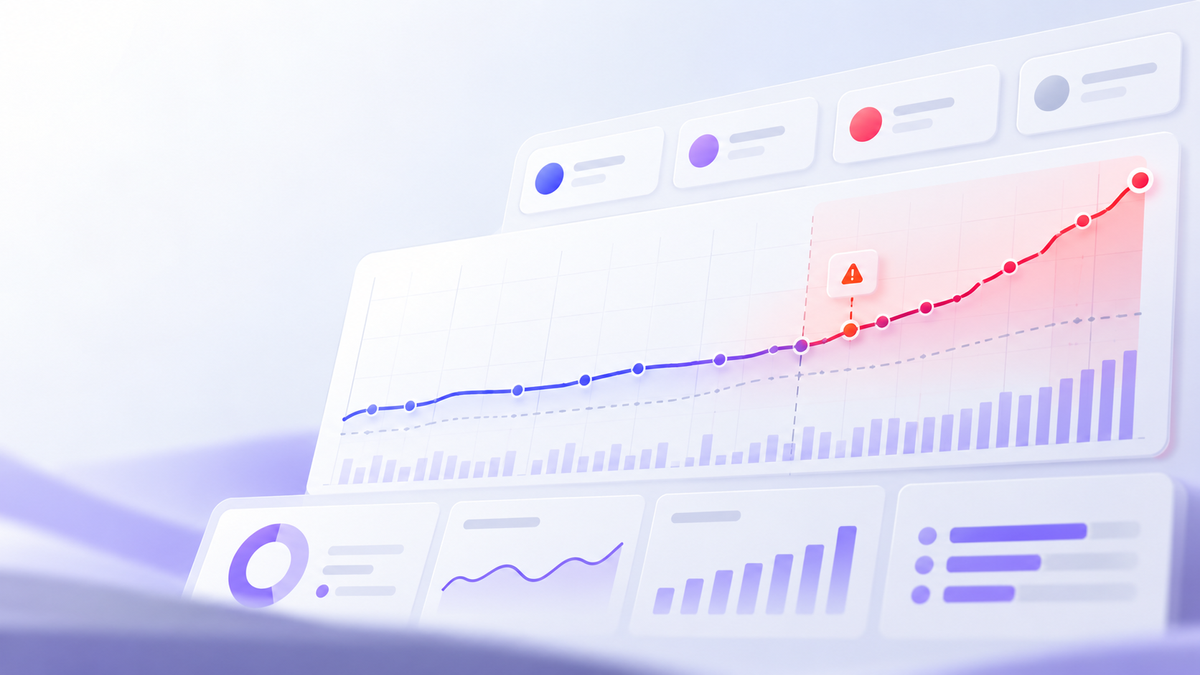
This is CPA drift: a gradual, sustained increase in cost per acquisition that can go unnoticed when you only look for sudden spikes.
The solution is not to panic over every daily fluctuation. It is to compare performance against a meaningful baseline, check whether enough conversions support the signal, investigate the likely cause, and make one deliberate change at a time.
Quick answer: How do you detect CPA drift?
CPA drift occurs when an ad set's cost per acquisition rises persistently above its historical baseline rather than experiencing a one-day fluctuation.
To catch it:
- Establish a baseline for each ad set using a comparable historical period.
- Compare recent CPA with that baseline.
- Check conversion volume and whether the direction persists across consecutive days.
- Investigate changes in creative performance, audience response, conversion rate, budget, tracking and lead quality.
- Make a controlled adjustment and measure the result before making another.
A single expensive day is not enough to prove drift. The important signals are the size of the change, the evidence behind it and whether it persists.
1. CPA spike vs. CPA drift vs. normal noise
These three situations can look similar on a dashboard, but they require different responses.
| Pattern | What it looks like | What to do |
|---|---|---|
| Normal noise | CPA fluctuates without a sustained change in the underlying trend | Continue monitoring; avoid unnecessary edits |
| CPA spike | CPA jumps sharply over a short period | Investigate tracking, delivery, auction conditions and conversion changes |
| CPA drift | CPA gradually and persistently rises above its baseline | Investigate the trend and make a measured intervention when evidence supports it |
Why the distinction matters: If you treat normal noise as a problem, you may change campaigns that were working. If you treat sustained drift as noise, you may allow inefficient spending to continue.
2. How a small CPA increase compounds
Consider a hypothetical campaign with a baseline CPA of ₹500 and a daily budget of ₹10,000.
At the baseline CPA, that spend would produce approximately 20 acquisitions per day, assuming the full budget is spent and the CPA remains stable.
Now suppose CPA gradually rises to ₹600.
| Metric | At baseline | After drift |
|---|---|---|
| Daily spend | ₹10,000 | ₹10,000 |
| CPA | ₹500 | ₹600 |
| Expected acquisitions at that CPA | 20 | 16.7 |
| Spend per day | ₹10,000 | ₹10,000 |
At ₹600 CPA, the same spend produces about 16.7 acquisitions instead of 20 on average.
That is approximately 3.3 fewer acquisitions per day at the same spend. Over seven comparable days, the difference would be about 23 acquisitions.
This is an illustration, not a forecast. Actual results depend on delivery, conversion volume, attribution and whether CPA remains at that level.
There is another way to view the problem. If you need 20 acquisitions at ₹600 each, you would need ₹12,000 rather than ₹10,000 in spend.
The campaign did not necessarily stop converting. It became less efficient at converting spend into outcomes.
3. A practical 3-day, 7-day and 14-day CPA review
Different review windows answer different questions. Use them to organize your investigation, not as universal rules for pausing or scaling campaigns.
The 3-day check: Did something change recently?
Look for recent changes that could explain a deterioration:
- Did a creative, audience, offer, landing page or budget change?
- Did conversion tracking or the lead pipeline stop recording correctly?
- Did CPA move in the same direction for multiple days?
- Is the conversion count large enough to make the change informative?
A three-day window is useful for spotting recent movement. It may be too short to establish a reliable trend for campaigns with low conversion volume.
The 7-day check: Is the pattern persisting?
Compare the recent seven days with a relevant earlier period. Use consistent attribution settings and avoid comparing periods with materially different delivery conditions without accounting for those differences.
Ask:
- Is CPA consistently above the baseline?
- Is conversion volume also changing?
- Is click-through rate declining?
- Is the landing-page conversion rate falling?
- Are leads becoming less qualified even if conversion volume looks stable?
If the evidence is mixed, keep investigating rather than forcing a conclusion.
The 14-day check: Is the campaign's efficiency changing structurally?
For campaigns with enough data, a longer window helps distinguish a short-lived fluctuation from a sustained change.
Review:
- CPA against its historical baseline
- Conversion volume and cost per conversion
- Creative-level CTR and frequency trends
- Landing-page and lead qualification rates
- Budget changes and delivery shifts
- Tracking consistency and attribution changes
Fourteen days is not automatically the correct baseline for every account. Choose comparison windows that reflect the campaign's volume, conversion cycle and operating conditions.
Important: These windows are a practical manual-review framework. AIChatAssist's actual drift methodology uses an ad set's own trailing baseline, conversion evidence and direction across consecutive days; the exact alert criteria should be taken from the configured product rules, not inferred from these example windows.
4. How to investigate the cause of CPA drift
A rising CPA is a symptom. You need to determine what changed before deciding what to do.
Check creative performance
Compare the creative's CTR, frequency and CPA with its own earlier performance.
If frequency rises while CTR declines and CPA increases, creative fatigue may be contributing. Frequency alone is not enough: a high-frequency ad can still perform well if the audience continues responding.
Check the conversion journey
If clicks are stable but conversions decline, inspect the landing page, form, checkout or WhatsApp qualification flow.
Look for slow loading, broken forms, confusing offers, poor mobile usability or a change in the proportion of visitors who complete the intended action.
Check lead quality
A campaign can maintain conversion volume while generating fewer qualified prospects.
For lead-generation campaigns, compare qualification rate and cost per qualified lead alongside platform-reported CPA. A cheap lead is not necessarily a valuable lead.
Check delivery and budget changes
Review recent budget adjustments, audience changes, placement mix and campaign structure. Compare performance over like-for-like periods where possible.
Avoid attributing every CPA increase to the auction or algorithm without evidence.
Check measurement before changing the campaign
A tracking failure can make a healthy campaign appear to deteriorate—or make a weak one appear healthy.
Verify that events are firing, conversion definitions remain consistent, and reporting or attribution changes are not driving the apparent shift.
5. When should you act—and when should you wait?
The decision depends on the strength of the evidence, the cost of waiting and the downside of making an unnecessary edit.
| Evidence | Reasonable response |
|---|---|
| Small change with few conversions | Gather more evidence and verify tracking |
| Sharp change after a known edit | Investigate the edit and affected funnel step |
| Sustained rise supported by meaningful conversion volume | Identify the likely cause and select one controlled intervention |
| CPA is stable but lead quality is declining | Audit qualification and downstream sales outcomes |
| Multiple signals conflict | Avoid stacking edits; gather clearer evidence |
Set CPA guardrails around the economics of the business, not a universal benchmark.
For example, a business that can profitably acquire a customer at ₹800 may have a different acceptable CPA from one whose margins only support ₹400. The threshold should reflect the actual conversion value, margin and business objective.
When a change is justified, make one edit, document why you made it, and give the campaign an appropriate observation period before stacking more changes. The aim is to learn what improved performance, not merely to produce activity in the account.
6. How AIChatAssist approaches CPA drift
AIChatAssist is built to help performance marketers identify meaningful campaign changes before they disappear inside routine reporting.
Its published methodology describes three key elements of CPA drift detection:
- Trailing baseline: Compare an ad set's CPA against its own historical performance.
- Conversion evidence: Consider how many conversions support the observed change, because small samples can fluctuate substantially.
- Consecutive-day direction: Check whether the change persists instead of treating a single daily movement as conclusive.
When a CPA guardrail is crossed with sufficient evidence, the system can flag the affected ad set and recommend a focused next step, such as reviewing budget, pausing or rotating creative. The operator should assess the context before acting.
This approach is designed to reduce reactive campaign management: fewer decisions based on isolated numbers, and more decisions based on the pattern behind them.
Read the AIChatAssist CPA drift and guardrail methodology for the definitions and decision logic.
Frequently asked questions
What is CPA drift in Meta Ads?
CPA drift is a gradual, sustained increase in cost per acquisition compared with a campaign or ad set's historical baseline. Unlike a sudden CPA spike, drift can develop slowly enough to escape single-day alerts.
How is CPA drift different from a CPA spike?
A CPA spike is a sharp short-term jump. CPA drift is a persistent upward trend. A spike calls for investigating what changed suddenly; drift calls for examining the pattern and the factors gradually reducing efficiency.
How many days should I use to detect CPA drift?
There is no universal number. Three-, seven- and fourteen-day views can help organize a manual review, but the right comparison depends on conversion volume, the sales cycle and campaign stability. Always compare against a meaningful baseline and check the evidence behind the trend.
Should I pause an ad set when CPA increases?
Not automatically. First check conversion volume, tracking, lead quality, creative performance and recent changes. If the rise is sustained and breaches your economically justified guardrail, consider a measured intervention based on the evidence.
Can high frequency cause CPA drift?
It can contribute when audience saturation reduces engagement and conversion efficiency. But frequency alone does not prove creative fatigue. Check frequency alongside CTR and CPA trends for the same creative.
Can Meta's automated rules detect CPA drift?
Rules based on fixed thresholds can catch certain changes, but they may miss gradual movement that remains below a fixed trigger. A baseline-based approach considers the ad set's own historical performance, conversion evidence and persistence of the trend.
How do I calculate the cost of CPA drift?
Compare the observed CPA with your baseline over a consistent period. To estimate the additional spend required for the same number of acquisitions, multiply the difference in CPA by the number of acquisitions you intend to generate. Treat this as an estimate, because campaign volume and performance may change.
Final takeaway: Stop reacting to isolated numbers
A campaign can become less efficient without suddenly breaking.
The practical response is to establish a credible baseline, monitor the direction of performance, validate the evidence, investigate the cause and make one deliberate adjustment at a time.
For agencies, that process also improves client conversations. Instead of explaining a rising CPA after the month is over, you can show what changed, what evidence supports the diagnosis and what action you recommend.
Frequently Asked Questions
What is CPA drift in Meta Ads?
CPA drift is a gradual, sustained increase in cost per acquisition compared with an ad set's historical baseline. Unlike a sudden spike, it can develop slowly and go unnoticed in daily reporting.
How is CPA drift different from a CPA spike?
A CPA spike is a sharp, short-term increase in acquisition cost. CPA drift is a persistent upward trend. A spike calls for investigating a sudden change, while drift requires examining the longer-term pattern.
How many days should I monitor to detect CPA drift?
Start by comparing recent 3-day, 7-day and 14-day trends against a relevant historical baseline. These are practical review windows, not universal alert thresholds. The right window depends on conversion volume, campaign stability and the sales cycle.
Should I pause an ad set when its CPA increases?
Not automatically. First verify tracking, conversion volume, creative performance, landing-page conversion rate and lead quality. Consider intervention when the increase is sustained, supported by sufficient evidence and above your business's acceptable CPA.
Can creative fatigue cause CPA drift?
Yes. Declining creative engagement can contribute to rising acquisition costs. Compare CTR, frequency, conversion rate and CPA over time. Frequency alone does not prove creative fatigue.
Can Meta automated rules detect CPA drift?
Fixed-threshold rules can catch certain CPA changes but may miss gradual deterioration that develops below a trigger. A baseline-based approach evaluates an ad set's historical performance and whether the change persists.
How do I calculate the cost of CPA drift?
Compare the current CPA with your baseline. Multiply the difference by the number of acquisitions to estimate the additional spend required to generate the same volume at the higher CPA.
For example, if CPA rises from ₹500 to ₹600 and you need 100 acquisitions, the estimated additional spend is ₹10,000. This is an illustrative calculation, assuming the higher CPA holds.
How can AIChatAssist help detect CPA drift?
AIChatAssist helps performance marketers monitor campaign signals against historical performance, identify sustained changes and prioritize investigations. Teams can use these signals to investigate budget efficiency, creative performance and lead quality before deciding what action to take.
Final Takeaway: Stop Reacting to Isolated Numbers
A campaign can become less efficient without suddenly breaking.
Establish a credible baseline, monitor performance trends, validate the evidence, investigate the cause and make deliberate adjustments.
Want to see where your Meta Ads performance is leaking? Request a Free Meta Ads Audit from AIChatAssist to review CPA drift, creative fatigue and lead-quality signals across your campaigns.
Want to see where your Meta Ads performance is leaking?
Get a Free Meta Ads Audit from AIChatAssist. Review CPA drift, creative fatigue and lead-quality signals across your campaigns, then prioritize what deserves attention first.
Note: Examples in this article are illustrative. Actual campaign outcomes and drift criteria depend on account data, conversion volume, attribution settings and business-specific CPA targets.