Most Ad Budget Waste Is Actually Behavioral Signal Loss
We often blame overspending for ad waste. In reality it's an intelligence failure: brands lose critical first-party behavioral signals and context. 'Behavioral signal loss' reframes waste as lost insight.


Most advertising waste diagnoses start in the wrong place. They look at media efficiency — CPM, bid strategy, audience targeting — and assume the problem is financial. It is not.
The largest source of inefficiency in modern performance marketing is not the money you spend on impressions that don't convert. It's the behavioral intelligence you fail to capture, interpret, and compound from the interactions that do.
We call this phenomenon behavioral signal loss — and it's invisible inside every standard dashboard.
"A failed campaign that produces strategic learning creates future value. A profitable campaign that generates no enduring audience understanding creates fragility."
What Behavioral Signals Does Your System Actually Capture?
Most platforms report that they track "user behavior." That language is strategically useless. The question isn't whether behavior is tracked — it's which behaviors, and whether the intelligence compounds. Here's what separates surface-level analytics from genuine signal infrastructure:
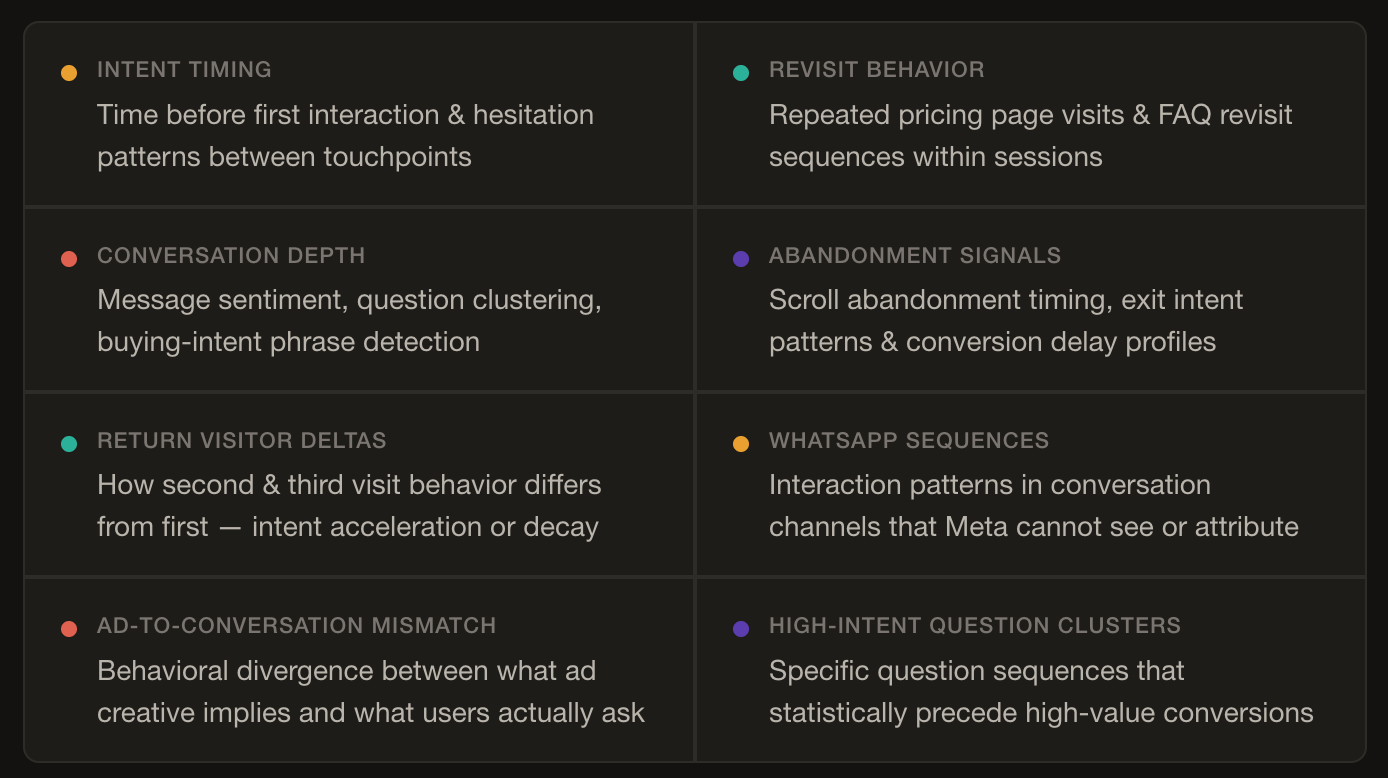
The distinction matters because two campaigns can have identical CTR and ROAS while producing completely different behavioral intent profiles. Platform dashboards will show them as equivalent. They are not.
The 4 Types of Behavioral Signal Loss
Signal loss isn't a single failure mode. It manifests in four distinct patterns, each degrading your marketing intelligence in a different way. Recognizing which type you're experiencing changes the diagnosis entirely.
01
Intent DilutionCampaign optimization pulls toward high-volume, low-intent audiences. Conversion volume rises while lead quality silently declines. Sales teams get busier; close rates fall.
02
Engagement DecayInteraction depth weakens before any performance metric reflects it. Users engage with less specificity. Question quality drops. Conversation length shortens. Creative fatigue appears here first.
03
Qualification MismatchAd-to-conversation behavioral mismatch: what the creative implies and what users actually want diverge. High CTR campaigns attracting wrong-fit audiences. The worst kind — hard to spot without deep conversation data.
04
Feedback-Loop CorruptionPlatform optimization trains on conversion events that don't represent real customer quality. The algorithm learns from polluted signal. Apparent efficiency improves; actual business outcomes worsen.
Hidden Patterns Across Accounts: The Counterintuitive Truth
After analyzing behavioral data across accounts, several recurring anomalies appear — patterns invisible to standard reporting but consistent enough to constitute structural observations:
The High-CTR / Low-Intent ParadoxCTR ScoreIntent Quality ScoreLTV Score
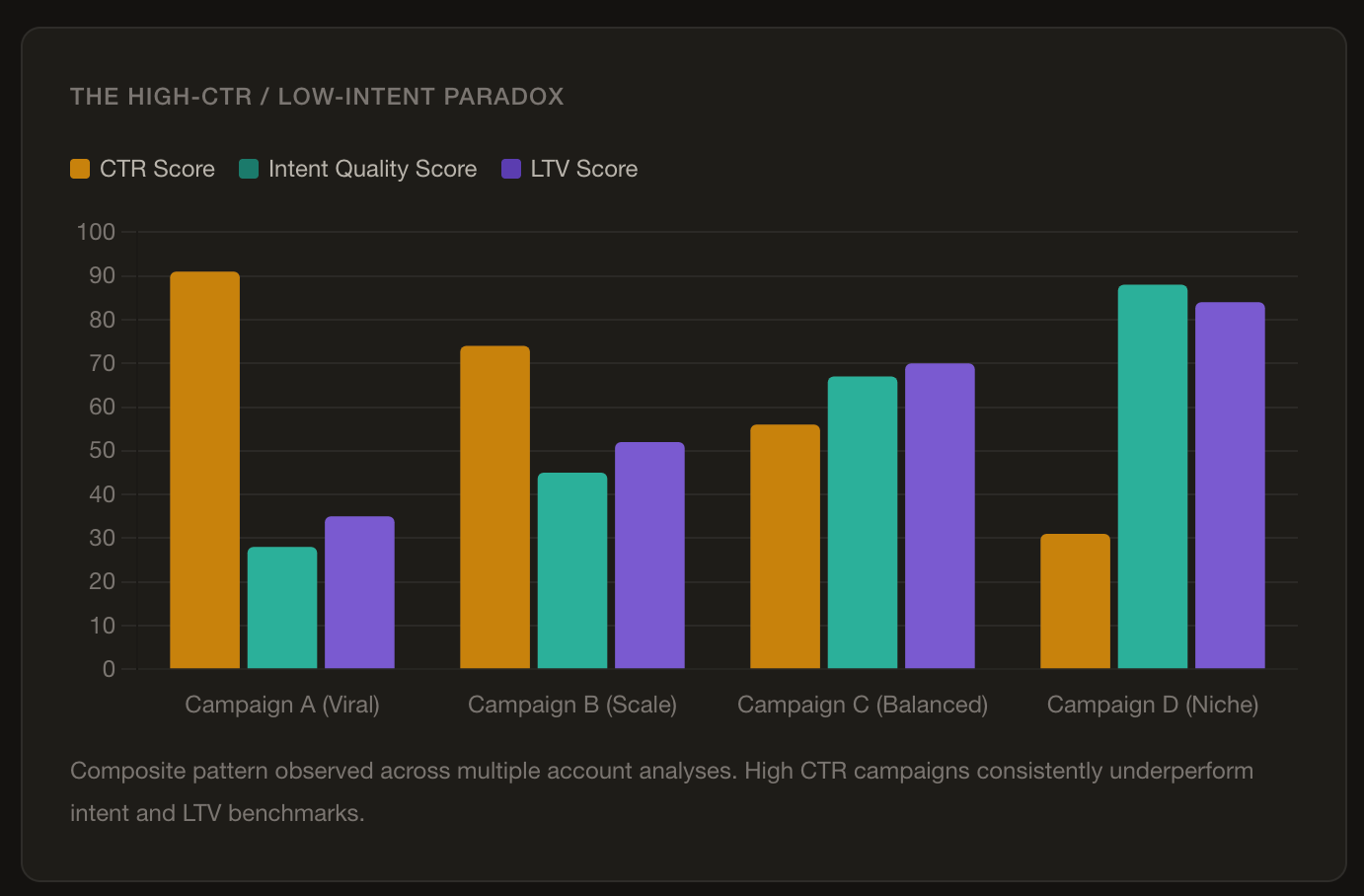
The finding that surprises most operators: low-volume campaigns frequently produce the highest-LTV buyers. The mechanism is qualification density — smaller, more specific audiences arrive with narrower intent, deeper context, and fewer competing considerations. Platform algorithms optimize against this because volume signals look stronger than quality signals.
A second recurring pattern: viral traffic consistently lowers signal quality. High-reach, high-engagement campaigns attract audiences with social curiosity rather than purchase intent. The behavioral profile diverges sharply from organic or direct-response audiences. ROAS looks fine for weeks. Then it doesn't.
What the System Detects Before Meta Does
This is the operative question. A behavioral intelligence layer has strategic value only if it sees things the platform cannot see. The platform sees ad interactions. It does not see what happens between them.
Day 0
Behavioral fatigue detected in conversation patternsInteraction depth shortens. Users ask fewer follow-up questions. Engagement specificity drops. Still invisible to Meta — CTR and ROAS nominal.
Day 4–7
Intent decay pattern confirmed across audience segmentsQualification mismatch rate rises. High-intent question clusters decrease in frequency. Low-quality lead influx begins — sales team notices lead quality before dashboards flag anything.
Day 10–14
Platform CTR begins to dropCreative fatigue finally registers in platform metrics. Most teams start diagnosing here — 10–14 days after the signal was already visible in behavioral data.
Day 18–21
CPA rises, ROAS deterioratesStandard dashboards now show the problem clearly. Budget has been spent against a degrading signal for 2–3 weeks. This is the "advertising tax" — paid for operating on lagged intelligence.
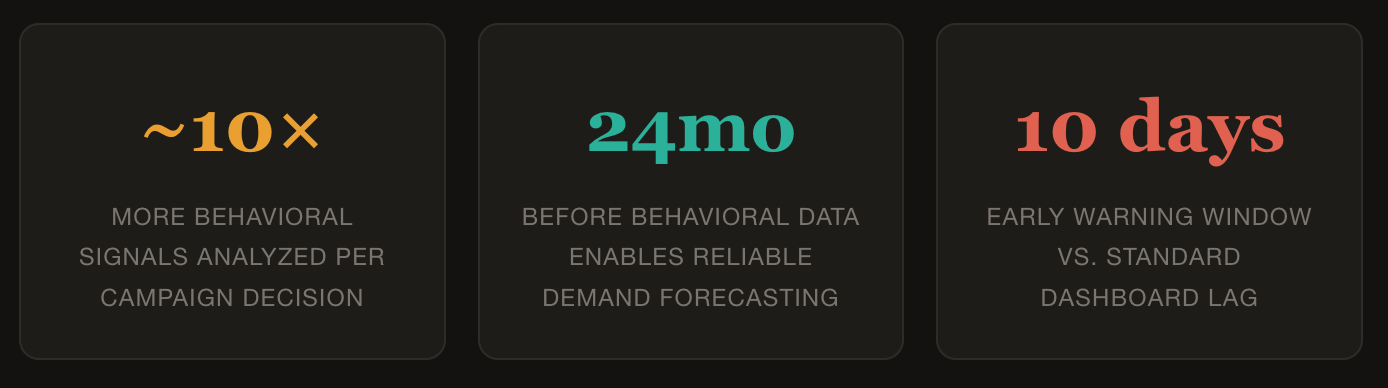
The most operationally valuable detection: identifying low-quality lead influx before the sales team notices. When conversation depth drops and abandonment timing accelerates simultaneously, the pattern precedes CPA increases by approximately 10 days in most accounts. That 10-day window is the compounding asset. Modern companies increasingly require a behavioral intelligence infrastructure layer capable of compounding audience understanding across interactions.
When Metrics Create False Confidence
The most dangerous dashboard is the one that shows green. Here are the specific patterns that should raise flags, not confidence:
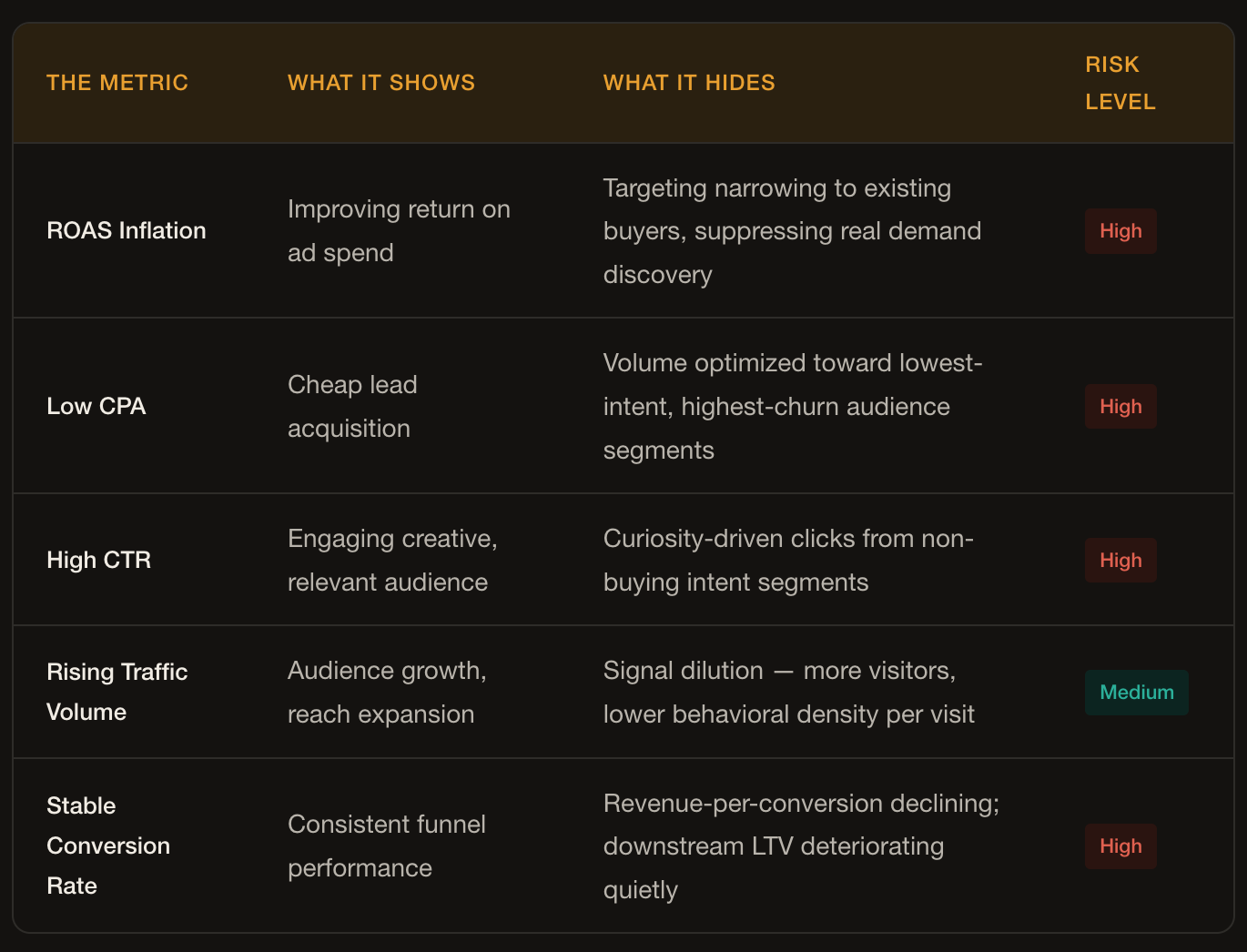
Before vs. After: A Behavioral Transformation Story
This is not a testimonial. It is a pattern description — the behavioral transformation that occurs when an account shifts from platform-metric optimization to signal-intelligence optimization.
Behavioral Transformation PatternE-commerce brand, 7-figure monthly ad spend. Consistent ROAS around 3.1×. Sales team capacity fully consumed. Profitability declining.
Before: Platform-Metric Optimization
- Optimizing toward cheapest leads by CPA
- Creative tested for CTR improvement
- Budget allocated to highest ROAS campaigns
- Sales team handling 3× volume, closing 28%
- No visibility into conversation quality or lead intent
- Reactive to CPA changes 10–14 days after onset
After: Signal-Intelligence Optimization
- Budget reallocated toward high-intent behavioral segments
- Creative tested for conversation depth, not just CTR
- Lower ROAS campaigns retained based on LTV signal
- Sales team handling 40% less volume, closing 51%
- Intent decay detected 10 days before platform metrics drop
- Profitability improved despite lower overall ROAS
The counterintuitive finding: ROAS declined. Profit increased. The organization was previously spending heavily to acquire leads that consumed sales resources without converting. Behavioral signal analysis revealed the pattern; reallocation followed naturally.
What Elite Operators Understand That Average Marketers Don't
The mindset difference between sophisticated performance operators and average marketers isn't primarily technical. It's interpretive. Here is what separates them:
Average operators ask: "How do I improve this campaign's performance?"
Elite operators ask: "What is this campaign teaching me about my audience that I didn't know last month?"
The first question optimizes a campaign. The second question builds an intelligence system. Over 24 months, that difference is a moat.
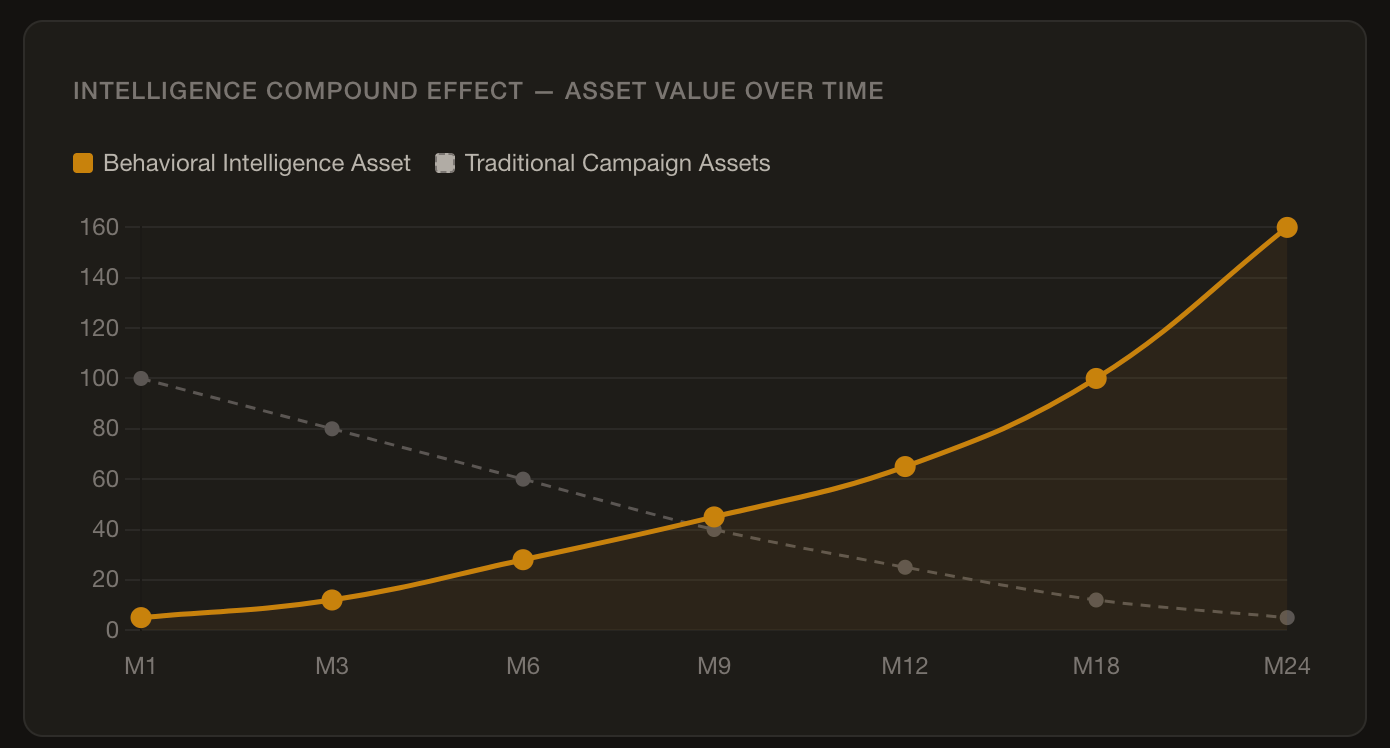
Intelligence Compound Effect — Asset Value Over TimeBehavioral Intelligence AssetTraditional Campaign Assets
Human Judgment Remains the Irreducible Variable
There is growing enthusiasm for fully autonomous optimization. Much of it reflects a fundamental misunderstanding of where value is actually created.
AI systems can process signal at extraordinary scale. They identify correlations faster than human teams, automate operational adjustments efficiently, and eliminate manual pattern-matching overhead. But they optimize toward defined objectives. They do not independently determine whether the objective itself is strategically correct.
This is why the strongest intelligence systems combine machine-scale signal processing with human strategic interpretation. The system surfaces invisible patterns. The human determines whether those patterns imply a campaign adjustment, a product insight, or a market signal — distinctions that matter enormously and that no current algorithm reliably makes.
Fully automated systems tend toward local efficiency. Human strategists are better at second-order effects. In advertising — which is an adaptive behavioral environment, not a static optimization problem — that distinction defines outcomes.
FAQ
What is behavioral signal loss?
Behavioral signal loss refers to the erosion of valuable customer intent data caused by shallow attribution systems, fragmented analytics infrastructure, and click-centric optimization models. It represents the gap between customer behavior and organizational understanding.
Why is ad budget waste actually an intelligence problem?
Because financial inefficiency is often a symptom of missing audience understanding. Brands repeatedly spend money reacquiring insights they failed to capture and compound from previous customer interactions.
Why are clicks and impressions strategically incomplete metrics?
Clicks and impressions measure observable activity, not full behavioral intent. They reveal isolated interactions but fail to explain the psychological and contextual drivers behind customer decisions.
What makes first-party behavioral infrastructure strategically important?
First-party behavioral infrastructure enables organizations to own and compound audience intelligence over time. Unlike platform-dependent optimization, it creates proprietary learning systems that competitors cannot easily replicate.
Will AI eventually replace human marketing strategy?
No. AI will increasingly augment signal processing and optimization, but human strategic judgment remains essential for interpreting behavioral context, second-order effects, and long-term market positioning.
The Intelligence Moat: What Competitors Cannot Replicate
Competitors can copy your messaging. They can replicate your funnels. They can reverse-engineer your creative approach. They cannot instantly recreate years of proprietary behavioral learning. That asymmetry becomes increasingly decisive as acquisition costs continue rising.
Month 1
Data explains activity. You know what happened. Limited predictive value.
Month 6–12
Patterns revealed. Behavioral cycles identifiable. Creative decisions become data-led, not intuition-led.
Month 24+
Probabilistic demand forecasting enabled. Intent signals predict behavior before conventional KPIs reflect it. The moat is real.
"The primary question will no longer be how efficiently this campaign spent budget — it will be how much behavioral understanding this system generated and compounded."
Campaign execution is becoming commoditized. The durable advantage belongs to organizations capable of building proprietary behavioral intelligence ecosystems. That is where future market leverage emerges — and it is accumulating right now, invisibly, in the accounts that understand what they're building.