AI ad reporting: Automated Decision Packages vs. Manual Reporting
Weekly reports show what happened. AI ad reporting tells you what to do next. Move from descriptive dashboards to prescriptive Decision Packages and stop the Reporting Lag Tax.

AI ad reporting: Automated Decision Packages vs. Manual Reporting
The campaign didn’t fail on Friday.
Friday is when your weekly report noticed.
What failed was the time between signal and action — the window where revenue bled and momentum died. That gap is a tax. I call it theReporting Lag Tax.
Key insight: Visibility without action is theatre. Automated Decision Packages move teams from reporting to intervention — from describing loss to stopping it.
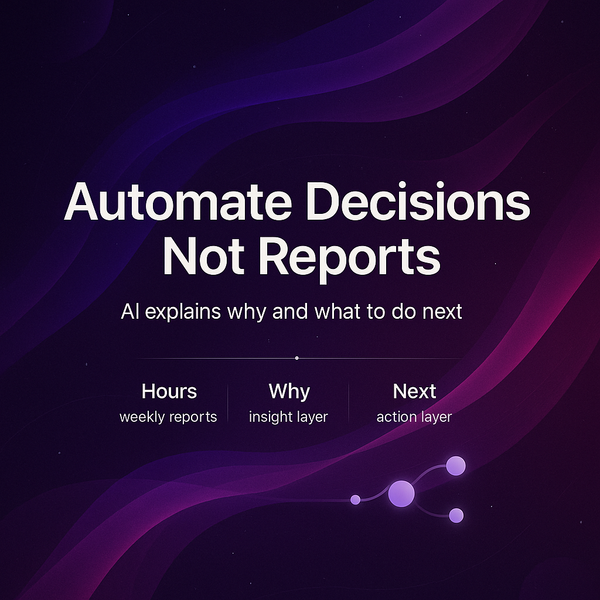
Here's the problem: your weekly report tells you what happened. AI tells you what to do next.
Most media buyers spend hours building weekly reports that line up metrics, slice audiences, and annotate anomalies. The report arrives. The meeting happens. Everyone nods. Then everyone moves on.
That sequence is the definition of latency. You didn’t need another chart. You needed a decision.
Direct claim
AI ad reporting, when used correctly, doesn't replace humans. It replaces waiting. It converts descriptive dashboards intoAI decision packages— concise, prescriptive bundles that explain root cause and recommend an action you can execute within the next work hour.
24/7
AI processes signals continuously — not just once a week.
What everyone gets wrong
Popular advice says: build better dashboards, hire senior analysts, check campaigns daily. Smart people believe that more visibility equals better outcomes.
That’s backwards. The missing variable isn’t visibility. It’s decision latency.
Why smart people believe dashboards fix it
- Dashboards centralize KPIs.
- Teams assume centralization leads to better coordination.
- Reports create a shared narrative about past performance.
Why it fails
Dashboards explain yesterday. They don’t tell you why a funnel fractured three days ago or what to pause before the next click wastes budget. By the time a human reads and debates the chart, the campaign has moved on.
The core claim: Automated Decision Packages replace manual reporting's role as a rear-view mirror
Decision Packages are not reports. They are micro-strategies: metric → root cause → action. That sequence answers three real questions a media buyer needs in the moment:
- What changed?
- Why did it change?
- What do I do next, right now?
Quotable axiom: Visibility without action is theatre. Insight without intervention is wasted intelligence.
The Anatomy of a Failure
Direct claim: most campaign disasters are chronological failures, not analytical ones.
Here’s a step-by-step breakdown that I’ve seen enough times to call a pattern.
- Early signal — Performance drifts. CPA creeps up; CTR falls. The shift is small and noisy.
- Detection delay — The drift only appears clearly in aggregate reports. Your weekly reporting cycle amplifies the signal but arrives too late.
- Debate delay — The team spends time debating causation: creative? targeting? attribution? Each hour of debate costs conversions.
- Execution delay — A recommended fix is implemented, often one-size-fits-all, because the team lacks a precise root cause.
- Partial recovery — The fix reduces damage but can’t reclaim lost days or recapture wasted spend.
That chain is what I call theDecision Latencycycle. Every link is an opportunity to stop the bleed earlier.
Comparison: Descriptive dashboards vs prescriptive AI packages
| Characteristic | Descriptive dashboard | Prescriptive AI Decision Package |
|---|---|---|
| Primary output | Charts and tables | Actionable directives (root cause + next step) |
| Timing | Periodic (daily/weekly) | Continuous or on-alert |
| Human time required | High — manual aggregation and interpretation | Low — human validates and executes |
| Decision speed | Slow | Fast |
| Primary value | Accountability and record | Prevention of revenue leakage |
The hidden cost nobody measures
Direct claim: the financial damage of slow decisions is not just the extra ad spend. It’s the missed conversions, lost learning cycles, and the habit of reacting too late.
Think about the funnel as a time-sensitive machine. A small drift left uncorrected compounds. That'sRevenue Leakage: a slow decay that never shows as a single headline metric but eats margin daily.
The Unit Economics (no invented numbers — variables only)
Direct claim: you can model the cost of delay with variables you already have.
Define:
- CPC = cost per click
- CTR = click-through rate
- CVR = conversion rate
- ACV = average conversion value
- D = delay in days until action
When performance drifts, CVR falls by delta_CVR. Expected lost revenue over delay D approximates:
LostRevenue ≈ TotalImpressions × CTR × delta_CVR × ACV × D
You already calculate these inputs. What you don't measure is D — the time-to-decision. Reduce D and you materially reduce lost revenue.
The Technical Bottleneck
Direct claim: the reason teams are slow is not lack of data or skill. It's a broken workflow that chains together brittle APIs, manual exports, and calendar-driven thinking.
What's actually failing:
- Data pipeline delays — metrics ship overnight or in batch exports.
- Human aggregation — CSVs and spreadsheets need curation.
- Analysis backlog — weekly meetings create a queue.
- Execution friction — changes require approvals and careful edits.
Deep-dive: Where APIs and human workflows collide
Ad platforms provide near-real-time metrics if you pull the right endpoints frequently.
But pulling is only half the job. You need:
- Continuous ingestion that normalizes timezones and attribution windows.
- Anomaly detection tuned for noise vs signal — not generic thresholds.
- A triage layer that maps anomalies to probable root causes (creative fatigue, audience saturation, attribution shifts).
- Pre-built action templates that translate root cause into a safe, reversible campaign change.
Most teams have step 1 fragmented across tools and step 4 manual. That creates the Decision Latency cycle.
How Automated Decision Packages work (the blueprint)
Direct claim: an effective Decision Package has three parts — Signal, Diagnosis, Prescription.
- Signal — a succinct description of what changed and where. Example: "CPA rose 18% in Audience A, last 24 hours."
- Diagnosis — likely root causes with confidence levels. Example: "Creative CTR fell 22% vs cohort; likely creative fatigue — confidence 78%."
- Prescription — a single, executable next step with rollback instructions. Example: "Pause Ad Set A, reallocate X% to Winner B, test new creative set on 10% holdback."
That entire bundle is what I mean by aDecision Package. It’s not an essay. It’s an instruction set.
3
Metric → Root cause → Action — the Decision Package formula.
Why Decision Packages preserve human creativity
Direct claim: automated prescriptions do not erase judgment; they free it.
If your team spends fewer hours building charts, they regain hours for strategy. That’s the point. AI should shrink the execution queue so people can do the high-value creative work machines can’t: narrative, brand voice, and experimentation design.
What the opposition says — and why it’s incomplete
Critics warn that automation will create formulaic advertising and hollow creative. I agree in part. If you treat Decision Packages as final say, you create dumbed-down creative ecosystems.
But that’s not the only choice. The better path: use AI to preserve margin and speed, not to dictate messaging. Position AI as an assistant that flags problems and suggests safe, reversible steps. Then let humans keep the creative control.
The Intervention Protocol — what to do now, exactly
Direct claim: every team should adopt a short protocol to convert signals into actions within one hour.
- Set alert thresholds — define what magnitude of drift triggers a Decision Package (not every blip matters).
- Automate triage — map common anomalies to tested prescriptions (e.g., creative fatigue → creative rotation).
- Pre-approve micro-actions — create a playbook of safe moves that can be executed without full approval (pause, reallocate up to X%).
- Design reversal plans — each action includes how to revert and how to measure recovery within 24–72 hours.
- Allocate human hours — shift media buyer time from report building to strategic tasks and campaign experiments.
Why one-hour matters
Think about the difference between a reaction in one hour and a reaction in one week. The money you would have spent in those intervening days — plus the lost conversions and lost signal for learning — is compounding damage. One hour is an operational goal that forces you to streamline decisions, not paperwork.
Operational checklist for adopting AI decision packages
- Replace weekly report ownership with Decision Package ownership.
- Integrate continuous feeds from Meta/Google into your diagnostics layer.
- Define 10 common failure modes and a one-paragraph prescription for each.
- Pre-authorize micro-adjustments to campaign budgets and targeting.
- Measure time-to-decision as a performance metric.
Practical examples (no fictional clients — just patterns)
Direct claim: these are repeatable patterns. You will recognize them.
- Creative fatigue — Desc: CTR falls; Diagnosis: audience sees same creative; Prescription: rotate creative subset to 25% and hold a new creative test.
- Audience saturation — Desc: Frequency up, conversions down; Diagnosis: audience exhausted; Prescription: reduce spend to the audience and expand lookalike at 2%.
- Attribution shift — Desc: conversions shift across channels; Diagnosis: tracking pixel delays or last-click noise; Prescription: run parallel measurement and pause suspect re-targeting for 48 hours.
Each of these Decision Packages should be delivered in one concise message with a confidence level and rollback plan.
Tools and integration notes
Direct claim: you don't need a monolithic platform to get started. You need three capabilities.
- Continuous ingest — near real-time pull from ad APIs and conversion endpoints.
- Automated diagnostics — rules and models that map metric shifts to probable causes.
- Action templates — pre-built, reversible steps that an operator can run in minutes.
Build these pieces incrementally. Start with the top five failure modes that cost you the most money and automate their detection and response.
Strategic insight: measure decision latency, not just CPA
Direct claim: Decision Latency belongs in your executive dashboard.
Track time from alert to action and compare outcomes. You will find a correlation: faster decisions reduce the size of recoveries and increase learning velocity. That’s the operational lever you actually control.
Culture: changing the team's rituals
Direct claim: switching to Decision Packages changes how teams spend time.
Obvious ritual change: stop baking your week around the Friday report meeting. Instead, schedule short, focused decision reviews and reserve creative time for ideation, not data assembly.
Policy: guardrails that keep AI as an assistant
- AI suggests; humans approve when confidence below threshold.
- All automated actions must include a rollback window.
- Keep human-in-the-loop for creative and brand-level decisions.
What success looks like
Direct claim: success is not fewer reports. Success is faster, better decisions.
Operational signs of success:
- Shorter time from anomaly to action.
- Fewer multi-day performance drifts.
- More human hours devoted to strategy and creative tests.
- Smaller recoveries from anomalies because issues are caught earlier.
Why this matters now
Direct claim: markets punish slow responders. The brands that win are the ones that keep their funnels humming and learning intact.
If your current process treats reports as the product, you are subsidizing delay. Shift to Decision Packages and you stop the leak before it compounds.
Controversial close
Stop paying media buyers to build dashboards that only explain yesterday. Pay them to make better decisions tomorrow.
Expert opinion: The goal is not monitoring. The goal is intervention. Reduce decision latency and you protect margin.
FAQ
How does AI ad reporting differ from traditional reporting?
AI ad reporting moves beyond describing performance to prescribing immediate steps. Traditional reporting aggregates past metrics into charts. AI ad reporting generates Decision Packages that map metric changes to likely causes and recommended actions you can execute quickly, reducing time-to-decision and preventing revenue leakage.
Can Automated Decision Packages replace media buyers?
No. Automated Decision Packages are designed to reduce repetitive analysis and speed interventions, not to replace human judgment. They free media buyers to focus on creative strategy, testing, and higher-level decisions while handling continuous triage and routine fixes.
How do Decision Packages preserve creative control?
Decision Packages recommend operational moves (pause, reallocate, test) with rollback plans. They do not author creative direction. Humans maintain control of messaging, experimentation design, and brand decisions while using AI to protect performance and free up strategic time.
What technical changes are required to implement prescriptive analytics?
Implementing prescriptive analytics requires continuous ingestion of ad and conversion data, anomaly detection tuned for ad noise, a diagnostic layer to map anomalies to causes, and action templates for safe execution. Integrations with ad APIs and predefined guardrails are essential.
How should teams measure success after adopting Decision Packages?
Measure time-to-decision and the frequency of multi-day performance drifts. Track human hours reallocated to strategy and the number of safe automated interventions. These operational metrics show whether you’re reducing decision latency and protecting margin.