Qualified Traffic vs. Vanity Traffic — AI Filter for Meta Ads Traffic Quality
Meta's auction finds clickers, not buyers. Use Behavioral Signal Intelligence to score intent pre-bid and reduce the Decision Latency Tax on ad spend.

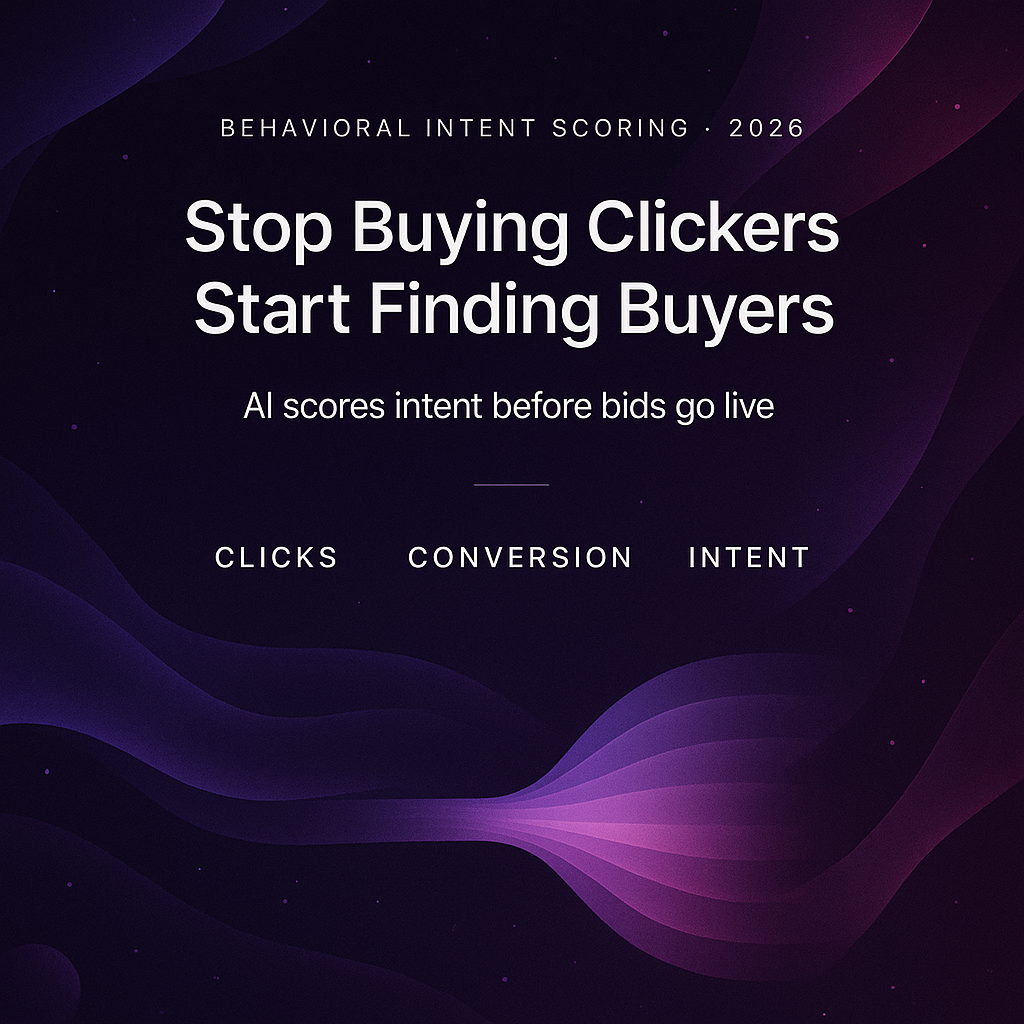
Qualified Traffic vs. Vanity Traffic: The AI Filter for Meta Ads Traffic Quality
They launched a new product and the dashboard cheered. Clicks spike. CTRs looked healthy. The finance team called it growth. Then the pipeline stalled and the next board deck had an empty revenue slide.
Meta's algorithm did exactly what it was trained to do: find people who click. The campaign did exactly what the team asked: maximize click signal. The business did not get what it paid for: buyers.
Key Insights
Meta's algorithm optimizes for the click signal. You need an operational layer that scores buyer intent before you pay for the click. Call itBehavioral Signal Intelligence.
Hook: The launch that looked healthy until it wasn't
Here's the problem. The campaign dashboard showed volume and velocity. The cost per click was within expectation. The team optimized for CTR and engagement. But the conversion column told a different story.
Think about it. You can run an ad that every human will click. That doesn't mean any of them are buyers.
What's actually happening: why Meta ads traffic quality diverges from business outcomes
Direct claim: Meta's objective is not your buyer list. It's to surface the strongest click signal for the auction.
Explanation: The platform receives a reward when users click, engage, and generate short-term metrics it was instrumented to value. That creates an optimization loop aimed at the easiest signals to model — clicks, impressions, reactions — not the slower, rarer signals of purchase intent.
That means your feeds are full of people who look like good statistical clicks but behave like non-buyers post-click.
What everyone gets wrong (and why smart teams make the same mistake)
Popular advice: Optimize for CTR, then for conversion events. It sounds reasonable.
Why smart people believe it: Clicks are high-frequency signals. They come fast. They let you iterate. They reduce variance in short-term testing.
Why it fails: The platform's short-term signal alignment creates a structural divergence between the auction's notion of a 'good outcome' and your business's notion of a 'good customer'. You recruit attention, not buyers.
The hidden cost nobody measures
Direct claim: The real damage is not the wasted ad dollar. It's the compound cost to the campaign's signal profile and to your future bidding.
Explanation: When the ad auction delivers clickers who don't convert, two things happen. First, the campaign's historical data anchors to low post-click quality. Second, the platform interprets your event data as weaker signals of buyer behavior and pushes spend toward similar users. That's a feedback loop. Over days it becomes a habit. Over weeks it becomes the campaign's normal.
This is the Decision Latency Tax: ad dollars spent today that increase the probability of more low-quality traffic tomorrow.
Core claim: Meta finds clickers. You must find buyers before the bid.
Direct claim: If you do not surface buyer intent signals into the auction, you will keep paying for clicks that never become buyers.
Explanation: The auction optimizes for the signals you feed it. If your only signal is a click, it will find more click-like users. If your signal is a high-probability buyer score, it can target profiles that match buyer behavior — but only if you can provide that signal at the right latency.
Introducing the corrective: Behavioral Signal Intelligence
Direct claim: Add a filter that scores intent before the auction. Use behavioral data to label traffic and feed a buyer signal back into the platform.
Explanation: I call this operational layerBehavioral Signal Intelligence. It sits between ad click and conversion. It observes pre- and post-click micro-behaviors and assigns a probability of purchase — before the conversion event even happens.
This is not retroactive attribution. It is proactive scoring that changes who you bid on.
How Behavioral Signal Intelligence changes the optimization loop
Direct claim: The loop must be buyer-signal → auction → delivery → sample → re-score → feed back.
- Instrument post-click micro-behaviors (time on page, navigation depth, scroll patterns, form interactions).
- Score each session with an intent probability in real time.
- Use that score to set bid modifiers, exclusions, or audience layers before the auction finalizes bids.
- Capture outcomes and update models to reduce decision latency.
That's the technical loop. The operational discipline is closing it in hours, not weeks.
Anatomy of a failure: step-by-step breakdown
Direct claim: Campaigns fail not on a single misstep but from a sequence of neglected latency gaps.
- Monday: Campaign launches. Optimization set to link clicks; creative aimed at curiosity. Early volume looks good.
- Tuesday: CTR climbs. The algorithm doubles down on audiences that click easily.
- Wednesday: Sales don't move. The team adds conversion pixels to the post-click page and waits for data to accumulate.
- Thursday: Campaign has gathered more click data — the wrong type. It cements those signals as winners.
- Friday: The bid density is higher for cheap-click segments. The auction marginally favors clickers over buyers.
- Following week: The campaign's baseline has shifted. Recovery requires more aggressive intervention than originally thought.
The failure starts early. Reports notice it late.
Unit economics: how low-quality clicks leak profit
Direct claim: Stop paying for volume; optimize for qualified cost metrics.
Explanation: You must make the math explicit. Use simple algebra to expose leakage.
Basic leakage formula
Let CPC = cost per click. Let CR_clicker = conversion rate among people recruited by click-optimized traffic. Let CR_buyer = conversion rate among traffic filtered by intent-scoring. CPA = CPC / CR.
CPA_clicker = CPC / CR_clicker
CPA_buyer = CPC / CR_buyer
If CR_buyer > CR_clicker, then CPA_buyer < CPA_clicker. Shifting the denominator reduces cost per acquisition without necessarily reducing volume.
That algebra shows the direction of travel. It does not invent numbers. It exposes choices.
The technical bottleneck: where latency kills accuracy
Direct claim: Most implementations fail because the intent score arrives too late or not at all.
Explanation: There are three common integration mistakes.
- Batch-only scoring: Models run hourly or daily and update audiences after the auction has already used the wrong signals.
- Postback-only signaling: Scores are only returned after a conversion. That helps attribution but not bidding.
- Thin instrumentation: Only a handful of events are tracked, missing the behavioral micro-patterns that separate buyers from clickers.
What's actually needed is real-time scoring and a low-latency path into the ad decisioning process.
Implementation blueprint: the Intervention Protocol
Direct claim: A reproducible intervention protocol prevents revenue leakage before it compounds.
- Start with instrumentation. Track micro-behaviors on landing pages and during checkout.
- Build a real-time scoring model that outputs an intent percentile or probability within seconds of session start.
- Map scores to bid actions: exclude low-probability sessions, down-weight bids, or route to cheaper remarketing lanes.
- Feed outcomes back into the model continuously and monitor the CPA Drift Zone.
- Lock conversion-focused creative and placements once buyer-score cohorts prove lift.
Operational note: Execute this daily at first, then move to continuous if metrics justify the investment.
Comparison: Meta's click optimization vs AI intent optimization
| Dimension | Meta Click Optimization | AI Intent Optimization |
|---|---|---|
| Primary signal | Clicks, CTR | Behavioral intent probability |
| Latency | Immediate click-to-event; slow conversion mapping | Real-time scoring pre-bid |
| Outcome alignment | Attention metrics | Buyer conversion probability |
| Failure mode | High CTR, low conversion | Model drift if not re-scored |
| Best use | Top-of-funnel awareness | Bottom- and mid-funnel acquisition |
The operational checklist for reducing decision latency
- Instrument 10–15 micro-behaviors per funnel page.
- Score sessions within 3–10 seconds of page load.
- Push buyer-score signals into the auction as bid modifiers or custom audiences.
- Run A/B tests where the only variable is the buyer-score gating.
- Monitor the Revenue Leakage Window and intervene at the first sign of drift.
Do this before you add more reporting. Visibility without action is theatre.
Deep-dive technical analysis
Real-time scoring architecture (click to expand)
Direct claim: The architecture must be event-driven and stateless where possible.
Explanation:
- Client-side instrumentation emits micro-events to a streaming endpoint via a lightweight SDK.
- Events flow into a processing tier (Kafka / Kinesis / pubsub) that assembles session windows.
- A scoring service applies a pre-trained model to the session window and returns a score within seconds.
- The score is sent back to the ad server or to a decision service that adjusts bids via API.
Integration constraints to watch:
- Ad platforms often limit real-time external bid modifiers. You may need to implement server-side audience updates or use existing partner integrations.
- Privacy and signal loss: design the model to work with aggregated or hashed identifiers when necessary.
Model features that separate buyers from clickers
Direct claim: Not all features are equal. Focus on interaction patterns over single events.
- Navigation depth and back-and-forth behavior.
- Scroll velocity and dwell time in purchase-relevant sections.
- Form kinetics: fill speed, corrections, and abandonment timing.
- Source-to-page continuity: did the session come from a paid click or from an organic sequence?
How to run the experiments that convince executives
Direct claim: Run a clean A/B test where the only difference is whether the auction sees the buyer score.
Explanation: Set two identical campaigns. For the test cohort, push a pre-bid exclusion for low-intent sessions. For the control cohort, let the auction use its normal signals.
Measure: CPA, conversion rate, and long-term LTV signal quality. Do not confuse short-term volume with value.
What to say to your CMO when they ask why conversions lag despite great CTR
Here's the language that works. Say this:
"The auction is optimizing for short-term click behavior. We're paying for attention, not buyer probability. We need to inject a buyer signal into the bid decision or we'll keep retraining the auction on the wrong outcome."
That's direct. It frames the problem as operational and fixable.
Case for urgency: why wait increases the cost
Direct claim: Every day you do nothing, the auction collects a larger dataset of the wrong signal.
Explanation: That dataset compounds. It skews audience modeling and raises the marginal effort required to correct it later. This is not linear. It is path-dependent.
Call that the Campaign Intelligence Layer problem: your system will resist correction unless you reduce decision latency quickly.
Operational objections and how to answer them
Here's the problem: teams push back with three common objections.
- "We don't have the engineering bandwidth." — Response: Start with a lightweight event set and a rules-based scorer. Move to ML when you have validated lift.
- "Meta won't accept external signals in real time." — Response: Use partner integrations, audience APIs, or server-side audience updates. Work within platform constraints.
- "We don't want to reduce scale." — Response: Focus on efficient scale: fewer but higher-quality users convert at better unit economics and reduce the long-run Decision Latency Tax.
Strategic insight: Shift the objective, not just the metric
Direct claim: The single most effective change is objective re-specification: tell the auction about buyer probability.
Explanation: You cannot fix a mismatch by better reporting. You fix it by changing what the system optimizes for. Behaviorally score, then feed that score back into the auction. That simple shift reframes the entire optimization surface.
Practical next steps for founders and agency leaders
- Audit your campaigns: confirm if Meta ads traffic quality is the problem driving CPA drift.
- Instrument the funnel: add a small set of behavioral events across landing pages and checkout.
- Run a gating test: apply a simple buyer-score filter to 20% of traffic and measure CPA lift.
- If lift is positive, operationalize: move the scoring to real-time and integrate with ad bidding via available APIs.
- Measure signal decay and schedule continuous updates to the model.
Data cards: highlights that matter
1
Decision Latency is the hidden multiplier of wasted spend. It grows with each day you let low-quality clicks re-train your auction.
2
Behavioral Signal Intelligence is a corrective layer, not a dashboard. Its goal is intervention, not visibility.
Definitions
Behavioral Signal Intelligence: An operational layer that scores session-level buyer intent in real time using micro-behavioral signals and feeds that score into ad decisioning to prioritize buyers over clickers.
Decision Latency: The time gap between when a meaningful buyer signal exists and when you can use it to influence the auction.
CPA Drift Zone: The period after a campaign's signal profile shifts where cost-per-acquisition increases due to accumulated low-quality signal in the training data.
Closing provocation
The platform will do exactly what you reward it for. If you keep rewarding clicks, be ready to keep paying for them. If you want buyers, stop rewarding clicks alone. Score intent. Act fast. Retrain the auction on your terms.
FAQ
How do I know if Meta ads traffic quality is the problem for my campaigns?
Direct answer: Check whether CTR and click volume are high while conversion rate and qualified leads are flat or declining. Practical check: run a short X/Y test that compares normal targeting versus a buyer-score gated cohort and measure CPA and conversion quality over a week.
Can I implement Behavioral Signal Intelligence without a large engineering team?
Direct answer: Yes. Start with a minimal set of client-side events and a rules-based scoring layer. Validate the concept with a small A/B test before investing in ML and streaming infrastructure.
Does Meta allow external signals to influence bidding?
Direct answer: Not directly in all cases. Workarounds exist: server-side audience updates, partner integrations, and bid modifiers. The goal is to get the buyer signal into the decision surface before the auction finalizes bids.
What features should I track to predict buyer intent?
Direct answer: Track interaction patterns rather than single clicks. Examples: navigation depth, dwell time in purchase areas, form fill kinetics, and back-navigation behavior. Combine features for session-level scoring.
Will reducing low-intent traffic harm scale?
Direct answer: It may reduce raw volume but improves efficient scale. Fewer, higher-intent users often produce better CPA and lower long-term acquisition costs — and they reduce the Decision Latency Tax.
How quickly should I expect to see impact after implementing intent scoring?
Direct answer: You should measure initial signals within days; reliable impact on CPA usually appears within 1–4 weeks depending on traffic volume and model update cadence.
What is the first experiment I should run?
Direct answer: Route 20% of paid traffic through a pre-bid exclusion for low-scored sessions and compare CPA and conversion quality to the control. Keep creative and budgets constant.