How Performance Marketers Turn Losing Meta Campaigns Into Profitable Scale
A lot of Meta campaigns look profitable right before they collapse. This guide breaks down how experienced media buyers identify audience fatigue, signal deterioration, and hidden budget leakage before ROAS finally breaks.

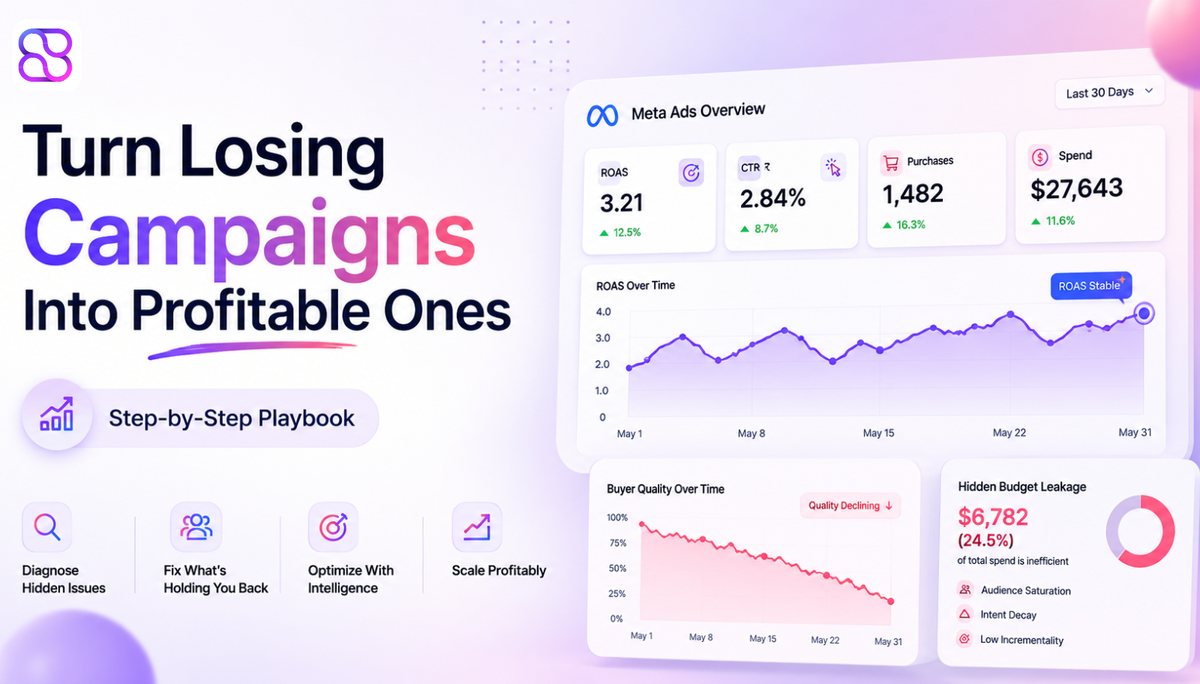
If you've been running Meta ads long enough, you know the feeling: spend is up, ROAS looks acceptable, and the dashboard shows nothing obviously broken. But conversions are quietly slipping. Cost per lead is creeping higher. Something is wrong — you just can't see it yet.
This is the modern Meta advertising problem. The visible metrics lag. By the time ROAS collapses, audience fatigue has already compounded, signal quality has deteriorated, and wasted spend has stacked up for weeks.
The good news? Most failing campaigns are not broken beyond repair. They're leaking performance in specific, diagnosable places — and experienced media buyers know exactly where to look.
In this guide, you'll get the step-by-step recovery framework that top performance marketers use to diagnose hidden inefficiencies, reduce CPA, improve ROAS on Meta ads, and rebuild scale intelligently — before wasted spend compounds.
ROAS Usually Breaks Last: Why Your Dashboard Is Lying to You
Here's the uncomfortable truth for every performance marketer running Meta ads in 2026: the metrics you check daily are the last ones to move.
By the time ROAS drops noticeably, Meta has already been expanding your reach into progressively weaker intent pools for days — sometimes weeks. Advantage+ and broad targeting accelerate campaign execution beautifully, but they also make audience decay and signal dilution nearly invisible until the damage is done.
What actually breaks first? Behavioral quality. The early warning signs appear through:
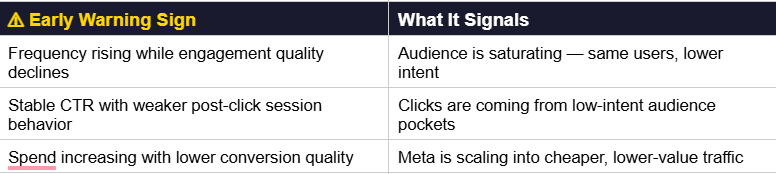
Stable ROAS can hide a campaign that's already breaking. Lower-quality customers, weaker lead intent, and declining margin quality don't show up in your Ads Manager dashboard.
This is why more performance marketers are turning to ai marketing campaigns intelligence to detect behavioral deterioration before it becomes a ROAS problem.
Where Campaigns Quietly Leak Performance
Every underperforming Meta campaign leaks efficiency somewhere. Experienced media buyers know there are three primary leak points — and all three typically compound together.
1. Audience Fatigue
Most advertisers identify audience fatigue far too late. By the time CPM rises and CTR drops, Meta has already cycled impressions into lower-intent pockets of your target audience. In 2026, broad targeting and aggressive AI optimization make this happen faster than ever before.
Broad targeting often performs best right before it quietly becomes expensive.
The fix isn't simply narrowing your audience. It's detecting the saturation signal early enough to act before performance deteriorates.
2. Creative Fatigue
Creative life cycles have shortened dramatically. In competitive niches, top-performing creatives can fatigue within days — not weeks — because AI-generated content velocity has exploded across every advertiser running in your space.
Most media buyers still wait for CTR collapse or CPM spikes to trigger a creative refresh. But fatigue starts earlier through declining engagement depth, weaker interaction quality, and reduced attention retention. By the time the metrics confirm it, you've already burned budget.
3. Signal Quality Decay
As campaigns scale, Meta expands reach and intent quality weakens. Low-value conversions increase. Audience precision dilutes. The algorithm is working exactly as designed — but the scaling is diluting the intelligence that made the campaign work in the first place.
A lot of campaigns don't fail because scaling stopped working. They fail because scale diluted audience intelligence faster than advertisers realized.
Case Study: What "Stable" Actually Looked Like Before the Collapse
The two performance snapshots below tell the full story. Look at what the dashboard showed before optimization versus what the data revealed after fixing hidden inefficiencies.
BEFORE: The Campaign Looked Fine on the Surface
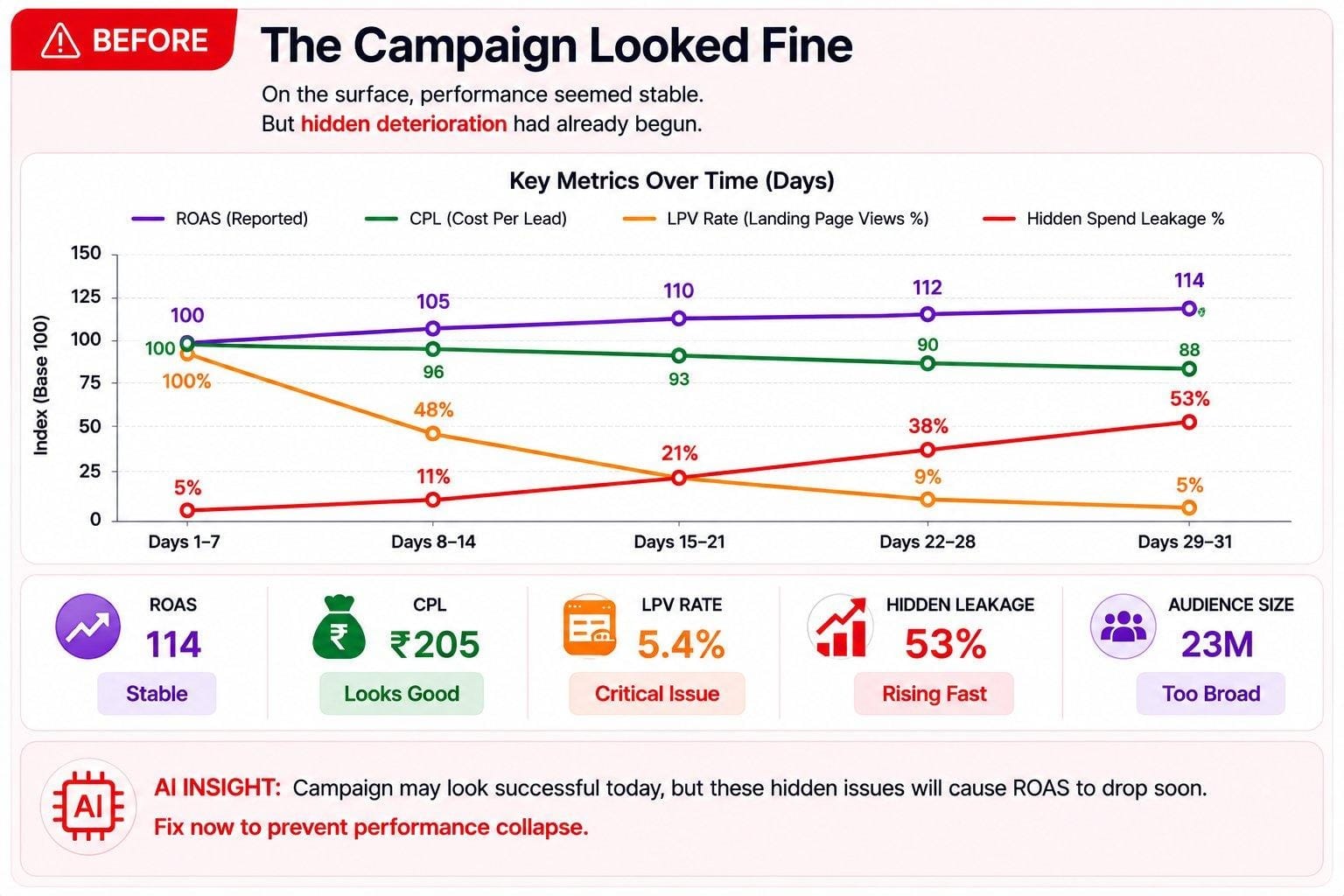
Notice that ROAS (purple line) was still climbing — from 100 to 114. CPL looked acceptable. But hidden spend leakage had already grown from 5% to 53%, and the LPV Rate (landing page views) had collapsed from 100% to just 5.4%. The audience size of 23M was far too broad, serving impressions to low-intent users at scale.
AFTER: What Changed After Optimization
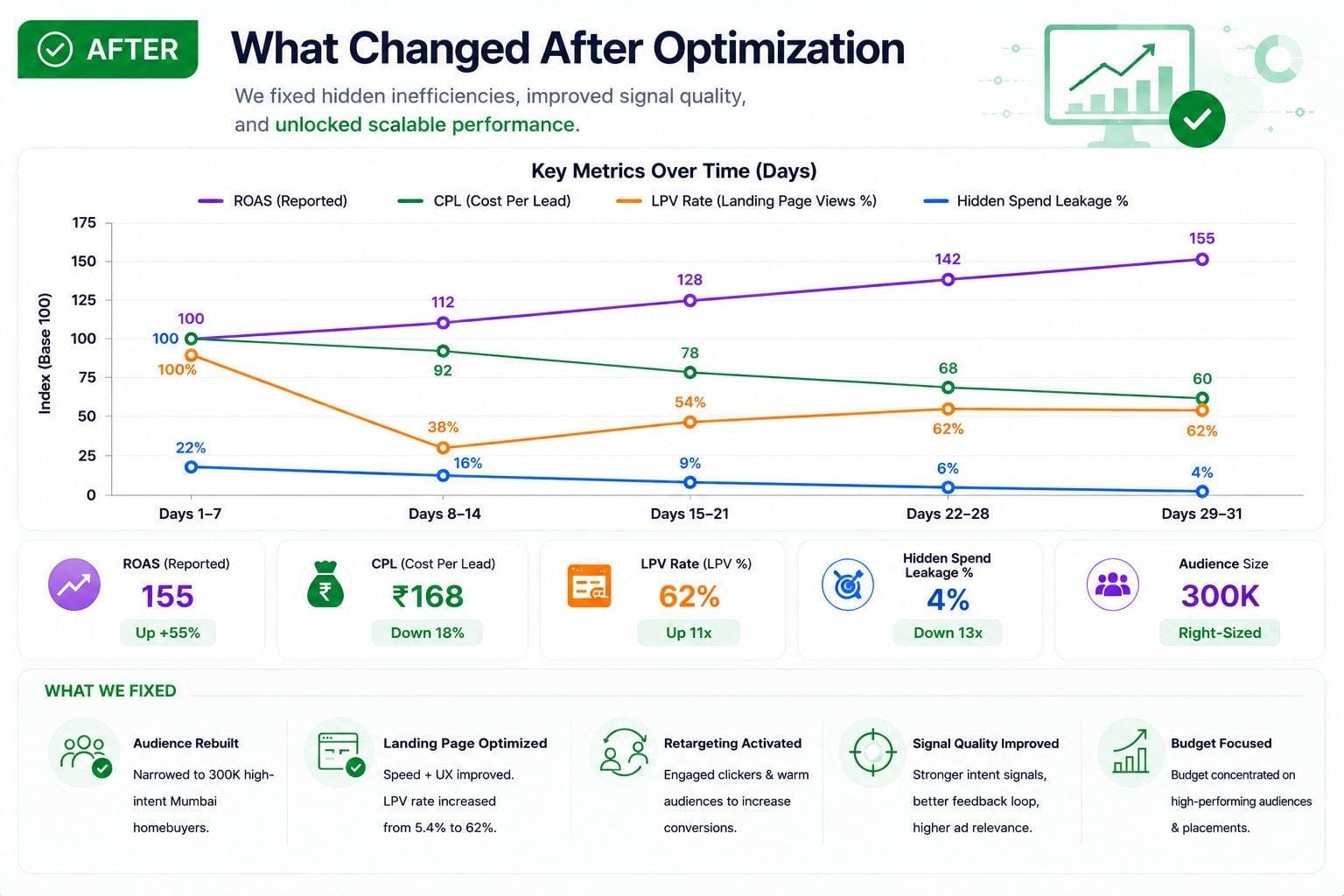
After fixing hidden inefficiencies: ROAS climbed from 100 to 155 (+55%). CPL dropped from ₹205 to ₹168 (down 18%). LPV Rate recovered from 5.4% to 62% (up 11x). Hidden spend leakage dropped from 53% to just 4% (down 13x). Audience was right-sized from 23M to 300K high-intent users.
The Campaign Recovery Framework Smart Media Buyers Use
Here's the step-by-step process experienced performance marketers follow when a campaign starts deteriorating — before they cut budgets, restart learning phases, or duplicate ad sets.
Step 1: Diagnose Before You Edit
The most common mistake? Reacting emotionally. Cutting budgets, duplicating campaigns, and over-editing too quickly resets the learning phase without solving the actual problem. Start by isolating where deterioration began — audience quality, creative fatigue, or signal decay.
Step 2: Audit Behavioral Performance
Go beyond surface metrics. Analyze engagement depth, session quality, audience interaction behavior, and conversion intent signals. This is where manual auditing becomes extremely difficult at scale — which is exactly why performance marketers are adopting automated ad campaigns and AI-powered intelligence tools to surface these signals in real time.
Step 3: Isolate the Weakest Variable
Determine whether the core problem is coming from:
- Audience quality (targeting too broad, audience saturated)
- Creative fatigue (frequency high, engagement depth low)
- Landing page friction (LPV rate collapsed)
- Scaling inefficiency (spend expanding into low-intent traffic)
- Weak conversion signals (Meta optimizing for wrong events)
Step 4: Reduce Budget Leakage
Before scaling, stop the bleeding. Focus on audience cleanup, creative refresh strategy, spend consolidation, signal refinement, and frequency stabilization. Budget leakage left unchecked compounds weekly.
Step 5: Rebuild Scale Intelligently
The goal is not to increase spend as quickly as possible. The goal is to improve campaign intelligence quality while scaling. Ask these questions before unlocking budget:
- Did audience quality improve?
- Did fatigue signals stabilize?
- Did engagement quality recover?
- Did signal quality strengthen?
- Did conversion quality (not just volume) improve?
This is where AI campaign manager tools create real leverage — detecting hidden budget leakage, audience decay, and fatigue patterns automatically, so you can act before wasted spend compounds.
Performance Marketing Is Now an Intelligence Game
Every performance marketer today has access to the same tools: AI creatives, broad targeting, Advantage+, automated bidding. These advantages are rapidly commoditizing.
The new edge belongs to advertisers who identify inefficiencies earlier, detect fatigue faster, understand audience behavior at a deeper level, and improve signal quality before wasted spend compounds.
Meta automation improved campaign execution. But it also made campaign diagnosis significantly harder. The platform runs faster — which means deterioration compounds faster too.
The performance marketers who outperform over the next five years won't just optimize better. They'll diagnose deterioration earlier than everyone else — and act on it while competitors are still staring at a ROAS number that looks fine.
Key Takeaways for Performance Marketers
Reducing CPA with AI and improving Meta ROAS requires detecting hidden inefficiencies, not just optimizing bids.
AI-powered ad campaigns and intelligence tools give you the diagnostic layer Ads Manager doesn't provide.
The recovery framework: Diagnose → Audit → Isolate → Reduce Leakage → Rebuild Scale.
Audience fatigue and signal quality decline weeks before dashboard metrics show it.
ROAS alone is no longer sufficient to diagnose campaign health in 2026.
Most Meta campaigns deteriorate gradually, not overnight — behavioral signals break first.
Frequently Asked Questions
Why are my Meta campaigns failing even when ROAS looks stable?
Meta campaigns failing with stable ROAS refers to hidden performance decline that dashboard metrics do not immediately show. A campaign may still generate revenue while audience quality, engagement, or conversion intent quietly weakens.
Common causes:
Audience fatigue
Low-quality traffic signals
Rising budget leakage
Poor landing page engagement
Try your Meta campaign analysis with AI Chat Assist to detect hidden inefficiencies before ROAS drops.
How do experienced media buyers recover failing campaigns?
Recovering failing Meta campaigns refers to identifying the real performance issue before making changes. Experienced media buyers diagnose where performance is breaking before scaling, pausing, or editing campaigns.
Recovery process:
Audit audience quality
Check creative fatigue
Identify budget leakage
Fix weak funnel signals
Studies show reactive budget changes often worsen campaign performance without proper diagnosis.
What causes audience fatigue in Meta ads?
Audience fatigue in Meta ads refers to users repeatedly seeing the same ads until engagement drops. This reduces click-through rates and increases ad costs over time.
Key warning signs:
Rising ad frequency
Falling CTR
Higher CPMs
Lower engagement quality
AI tools can detect fatigue early, helping advertisers refresh creatives before performance declines.
How can AI-powered ad campaigns help improve Meta performance?
AI-powered ad campaigns refer to using automation and behavioral signals to improve Meta ad performance in real time. AI helps marketers detect problems faster than manual reviews.
How AI improves results:
Detects budget waste
Identifies creative fatigue
Finds audience decline
Optimizes targeting automatically
Want to improve Meta ad performance? Try AI Chat Assist for real-time campaign monitoring and optimization.
Why is it harder to scale Meta ads profitably in 2026?
Scaling Meta ads profitably in 2026 refers to growing ad spend without hurting ROI or profitability. New automation features like Advantage+ increase reach but also reduce visibility into campaign issues.
Why scaling is harder:
Broader audience targeting
Faster spend expansion
Lower diagnostic visibility
More low-intent traffic
Marketers now need real-time optimization and behavioral insights, not just manual campaign edits.
Final Word: The Diagnostic Edge Is the New Competitive Moat
Meta's algorithm gets better at campaign execution every quarter. Creative tools are faster, targeting is broader, and bidding is smarter — for everyone. The platform-level advantages are equalizing.
What doesn't equalize is the ability to identify hidden campaign inefficiencies before they compound into budget waste. The media buyers who understand this — and build a diagnostic intelligence layer into their workflow — will continue to outperform while others react to problems that are already weeks old.
The competitive advantage is no longer just launching campaigns faster. It's identifying hidden inefficiencies before wasted spend compounds.
If your campaigns look stable today, that's not a reason to stop looking. That's exactly when the best media buyers start looking harder.