500K Views, Zero Sales: What Meta Experts Get Wrong

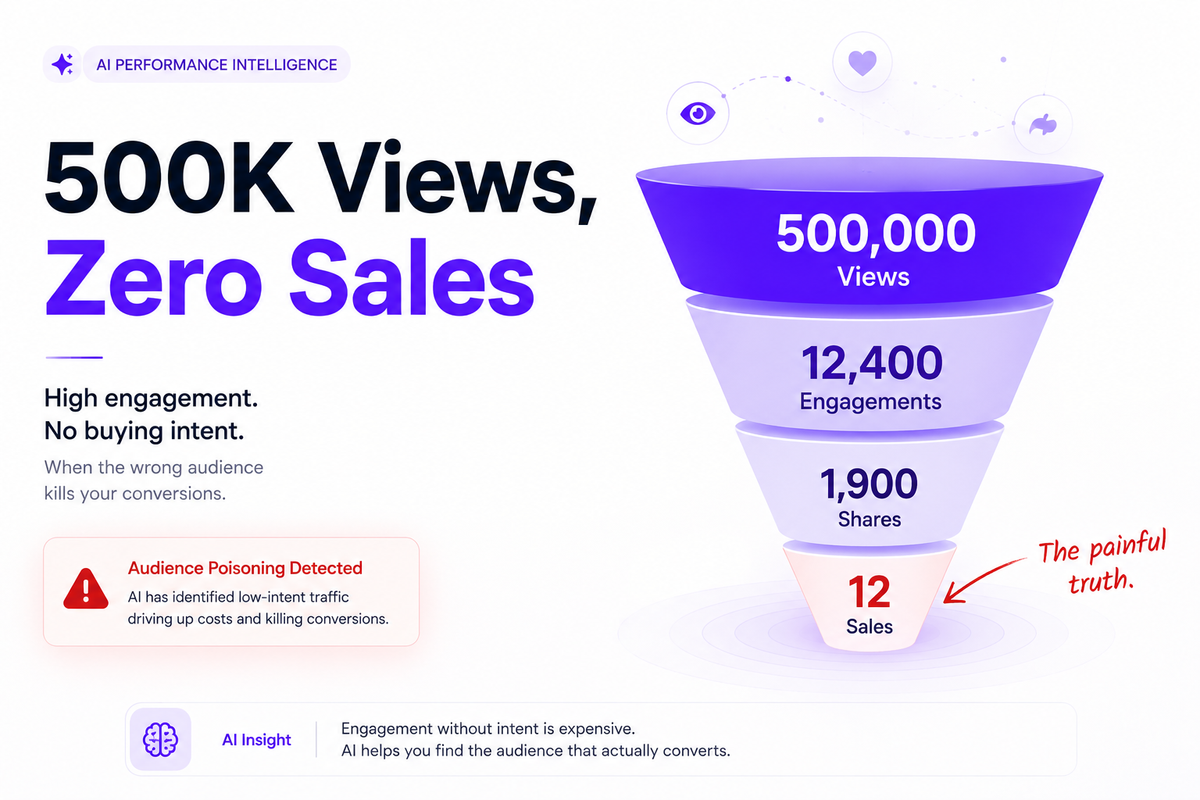
Your campaign just crossed 500,000 impressions. The client is screaming your name in the group chat. The creative team is celebrating. And your ROAS? It's in the gutter. CPA is doubling every 48 hours. You're watching six figures of budget dissolve into vanity traffic — and nobody in the room wants to say it out loud.
This is the performance marketer's dirtiest secret: viral traffic is often the fastest way to destroy a profitable Meta campaign. It inflates your numbers, flatlines your conversions, and poisons your pixel data for weeks after you've paused it.
And yet — most AI-powered ad campaigns are still being built around scale-first thinking, not intelligence-first thinking. That gap is where serious money gets lost.
🔥 If your Meta campaign is going viral but not converting, you're not a growth hacker — you're running overpriced brand awareness and calling it performance marketing.
This isn't a post for beginners. This is for media buyers, Meta experts, and performance marketers who are tired of half-measures and want the unfiltered playbook the top 1% actually uses.
⚡ Key Takeaways
- Viral traffic without conversion intent actively destroys account health and pixel quality
- The 7 deadly sins of Meta campaigns hit hardest when you're scaling fast and checking metrics slow
- Elite media buyers don't just optimize ads — they build real-time intelligence layers above the platform
- Automated ad campaigns with AI guardrails are the baseline in 2026, not a competitive advantage
- AI Chat Assist acts as an always-on co-pilot that catches CPA bleed before it compounds
1. Going Viral on Meta Is Often a Death Sentence for ROAS
Here's what actually happens when a creative goes viral on Meta: the algorithm sees explosive engagement signals and does exactly what it's designed to do — serve it to the broadest, most engaged audience possible.
The problem? Broad and engaged doesn't mean buying intent. You're now reaching people who double-tap everything, comment '🔥' on ads, share content they never act on — and your pixel is learning from every single one of them.
What follows is audience poisoning. Your custom audiences fill with curiosity-chasers. Your lookalikes start resembling scroll addicts instead of buyers. Your CPMs spike because you're competing for premium placements with low-quality traffic signals. And your learning phase gets corrupted with data that teaches Meta the wrong conversion patterns.
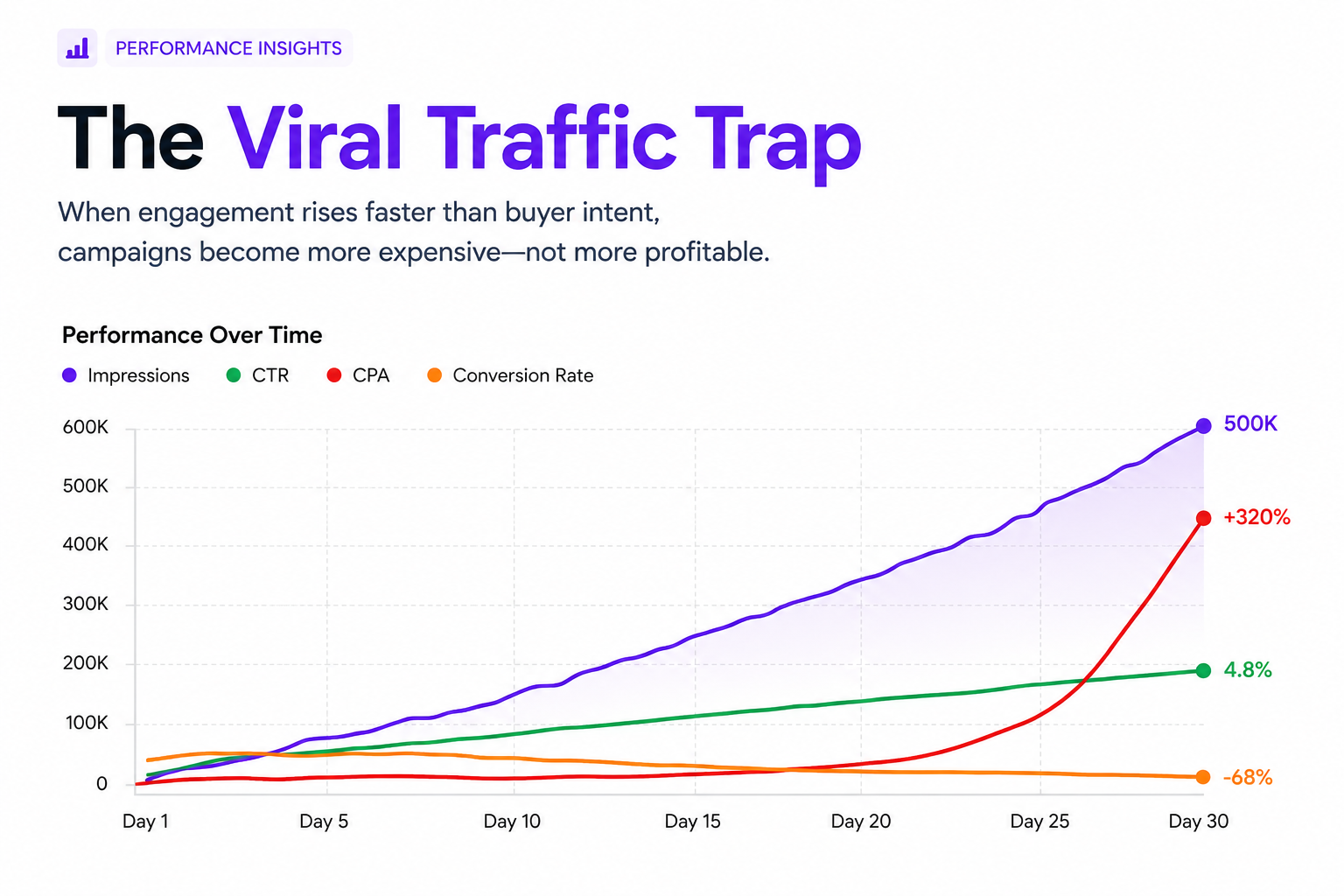
💡 Real benchmark: Average Meta conversion rates across industries sit between 1–3%. During viral traffic spikes with broad audiences, that rate can crater below 0.3% — a 10x efficiency collapse. Campaigns that go viral and aren't caught fast lose $10K–$100K before anyone runs the numbers.
The irony is brutal: the better your creative performs on engagement metrics, the faster it can destroy your campaign performance metrics. This is the trap that even experienced media buyers fall into — because the dashboards make it look like something good is happening.
🔥 Impressions are a vanity metric. Reach is a vanity metric. Even CTR is increasingly a vanity metric. The only number that pays your retainer is CPA — and viral traffic makes it bleed.
2. The 7 Deadly Sins Killing Your Meta Campaigns (Even at 500K Views)
These aren't beginner mistakes. These are the failure modes that burn experienced teams — because they're invisible in the native Ads Manager dashboard until it's too late.
Sin #1 — Creative Fatigue You Caught 72 Hours Too Late
Frequency crossed 3.5 three days ago. CTR dropped 22%. You didn't notice because you were monitoring weekly. By the time the algorithm flagged it, you'd burned a week's budget on a dead creative. The fix isn't a weekly check — it's automated creative decay detection.
Sin #2 — Audience Poisoning from Viral Curiosity Traffic
Every curious non-buyer who engages with your viral ad is now a data point in your pixel. Meta is learning from them. Your retargeting pools are contaminated. Your lookalikes are degraded. And you won't feel the effects until your next campaign launches cold — into the wrong audience.
Sin #3 — Attribution Black Holes
Post-iOS 14, a meaningful chunk of conversions simply disappear from your dashboard. If you're optimizing based on what Meta reports — and not running independent attribution — every decision you make is wrong by some percentage. Small errors compound into massive misallocations at scale.
⚠️ If you're trusting Meta's native attribution as your primary source of truth in 2026, you're running blind. Period.
Sin #4 — Budget Exhaustion Before Your Best Audience Shows Up
Viral traffic is front-loaded. It burns your daily budget in the morning, before your highest-intent audience segment comes online. By the time your actual buyers are scrolling, you're out of spend. Poor pacing kills qualified leads from Meta ads before the auction even starts.
Sin #5 — Landing Page Mismatch for Cold Viral Traffic
Your landing page was built for warm retargeting traffic — people who know your brand, trust your offer. Viral audiences are stone cold. They have zero context. A page built to close warm leads will confuse and lose cold traffic every single time. Different audience temperature = different page architecture.
Sin #6 — Offer-Creative Disconnect
The ad hooks them with one promise. The page delivers something slightly different. On a warm audience, that gap is survivable. On a viral cold audience with zero brand equity? They're gone in 3 seconds. Conversion rate drops to floor, CPA explodes, and you're left wondering why your 'best creative ever' isn't converting.
Sin #7 — No Real-Time CPA or Frequency Guardrails
This is the one that costs the most money. Most teams check metrics daily — some weekly. An AI campaign manager watching CPA trajectories in real time can flag a spike within hours. A human checking tomorrow morning has already lost the budget equivalent of a car payment.
🔥 Most self-proclaimed Meta experts are still flying blind with manual checks and gut feelings. By the time they 'optimize,' the campaign has already done the damage.
3. Budget Intelligence: What Elite Media Buyers Track That Others Don't
Native Meta Ads Manager gives you a rearview mirror. Top-performing media buyers need a windshield — and ideally, a predictive co-pilot.
Here's what the top 1% actually monitor, outside of what the platform shows you:
- CPA trajectory within the first 6 hours of launch — not end-of-day
- Creative decay rate by audience segment — not campaign-average CTR
- Cross-campaign audience overlap causing ad set cannibalization
- Frequency vs. CPA correlation — the point where frequency kills efficiency
- Pixel signal quality score and conversion event match rates
- Engagement-to-conversion ratio as an early warning system for audience mismatch
This is the intelligence layer that separates operators from amateurs. An AI marketing automation platform like AI Chat Assist surfaces all of this automatically — and tells you what's causing the problem and what to do about it, before it compounds into a budget disaster.
The Weekly Spend Intelligence Audit (Run This Without Exception)
- CPA by creative, not by campaign — granularity kills waste
- Frequency by audience segment — not blended average frequency
- Ad set overlap report — identify cannibalization before it tanks ROAS
- Attribution discrepancy check — compare Meta vs. independent source
- Creative decay flag — any CTR declining 15%+ week-over-week gets replaced immediately
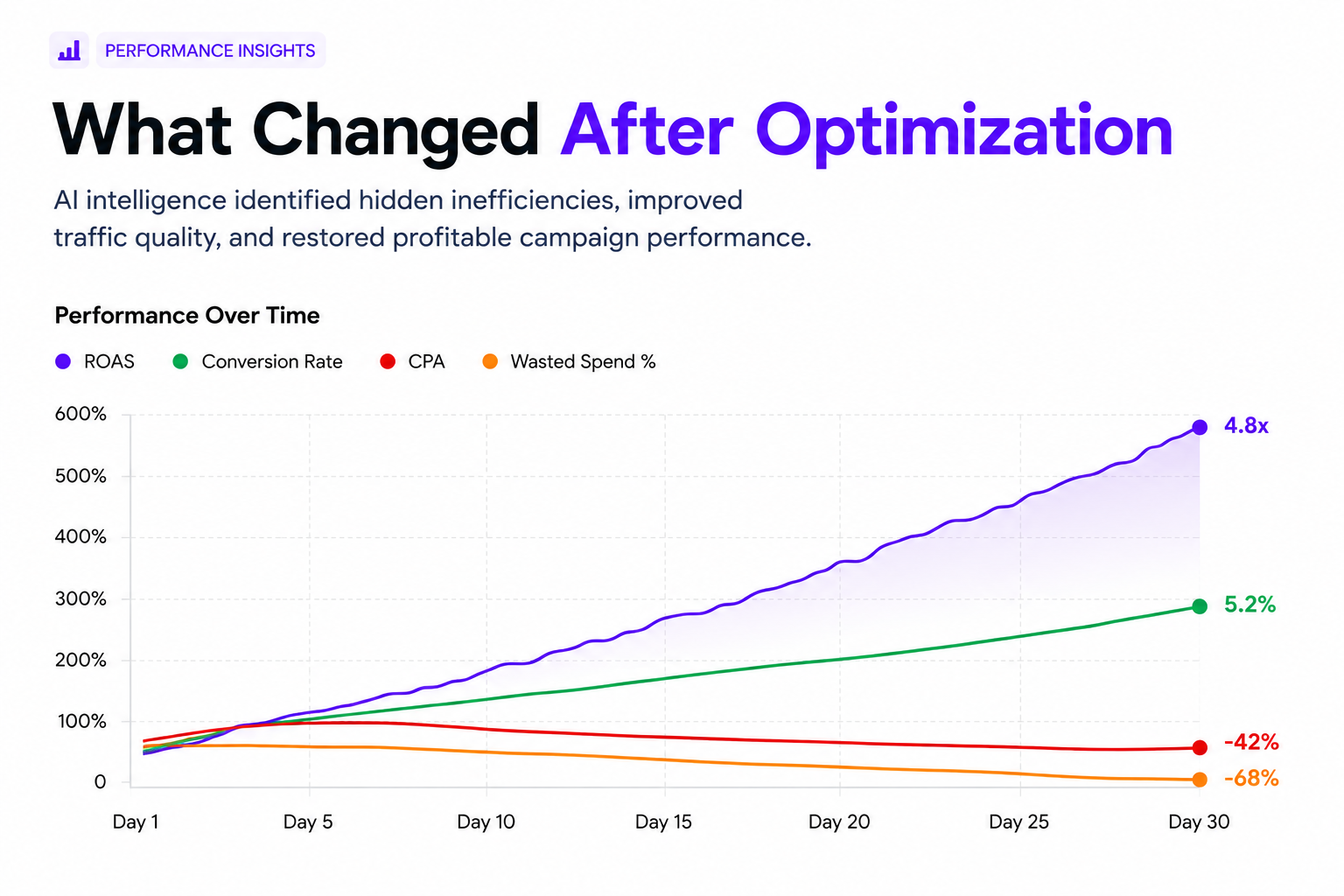
💡 Teams implementing this audit consistently recover ROAS from 1.2x to 4x+ within 30 days — not by spending more, but by surgically eliminating waste they couldn't see before.
4. The Advanced Playbook: Turning Toxic Traffic Into Profitable Conversions
When you detect a viral spike early, you don't just cut it. You weaponize the data you've already paid for. Here's what aggressive media buyers actually do:
Rapid Creative Refresh on AI Signal
When AI ad optimization detects engagement-to-CVR decoupling — high CTR but sinking conversion rate — you trigger an immediate creative swap. Not in the weekly review. Within 24 hours. You test a hard direct-response variant against the viral creative while the audience is still warm enough to retarget.
Retarget the Viral Engagers — Ruthlessly
Everyone who watched 3+ seconds of your video or engaged with your post is a warm signal. Build those audiences immediately. Hit them with a bottom-of-funnel offer: testimonials, specific ROI claims, scarcity. Reduce CPA with AI by letting the system identify which engagement profiles have the highest conversion probability based on historical data.
Negative Targeting During Viral Spikes
Add exclusion layers based on behavioral signals the moment you detect off-target traffic. If your vertical never converts a specific demographic but viral traffic is skewing toward them — exclude aggressively. Protect your pixel health. Every garbage conversion signal you prevent is one less corrupted data point poisoning your future campaigns.
Predictive Budget Reallocation Before the Dashboard Shows It
This is where performance marketing automation pays for itself. AI-driven systems shift budget from saturating ad sets to fresh high-potential audiences before performance degrades are visible in the UI. You're not reacting — you're preempting. That 24-48 hour advantage is worth thousands in protected spend at scale.
Build Intelligence Dashboards That Actually Matter
Stop reporting impressions and reach to clients. Build dashboards around:
- Cost per qualified lead — not cost per click
- ROAS by creative type and audience temperature
- Frequency vs. CPA correlation over time
- Conversion rate by audience segment — not blended rate
- Creative lifespan before decay — so you can predict refresh cycles
5. Scaling Without Self-Destruction: The Top 1% Mindset
The best media buyers in the world share one uncompromising trait: they kill losers fast and double down on winners without sentiment. They don't try to save a creative because the team loved it. They don't preserve an audience because it worked last quarter. They follow the data — and they have systems that make the data impossible to ignore.
Run Meta ads on autopilot doesn't mean set-and-forget. It means building intelligent automation that enforces discipline: auto-pausing ad sets when CPA exceeds threshold, triggering creative refreshes when frequency hits a ceiling, reallocating budget in real time based on live performance signals — not yesterday's report.
⚠️ Teams still running manual daily checks against competitors with real-time AI intelligence are in the same position as traders using Excel while the competition runs algorithmic systems. The gap widens every month.
Automated lead generation with AI gives compounding advantages: cleaner pixel data, faster creative learning cycles, tighter audience targeting, and more budget flowing toward qualified conversions instead of vanity traffic. This isn't theory — it's what's separating accounts that scale profitably from accounts that plateau and burn.
🔥 In 2026, running Meta campaigns without real-time AI intelligence isn't bold or scrappy — it's just expensive. The question isn't whether you can afford AI Chat Assist. It's whether your clients can afford you without it.
Frequently Asked Questions
Why are my Meta campaigns failing even when ROAS looks stable?
Meta campaigns failing with stable ROAS refers to hidden performance decline that dashboard metrics do not immediately show. A campaign may still generate revenue while audience quality, engagement, or conversion intent quietly weakens.
Common causes:
- Audience fatigue
- Low-quality traffic signals
- Rising budget leakage
- Poor landing page engagement
Try your Meta campaign analysis with AI Chat Assist to detect hidden inefficiencies before ROAS drops.
How do experienced media buyers recover failing campaigns?
Recovering failing Meta campaigns refers to identifying the real performance issue before making changes. Experienced media buyers diagnose where performance is breaking before scaling, pausing, or editing campaigns.
Recovery process:
- Audit audience quality
- Check creative fatigue
- Identify budget leakage
- Fix weak funnel signals
Studies show reactive budget changes often worsen campaign performance without proper diagnosis.
What causes audience fatigue in Meta ads?
Audience fatigue in Meta ads refers to users repeatedly seeing the same ads until engagement drops. This reduces click-through rates and increases ad costs over time.
Key warning signs:
- Rising ad frequency
- Falling CTR
- Higher CPMs
- Lower engagement quality
AI tools can detect fatigue early, helping advertisers refresh creatives before performance declines.
How can AI-powered ad campaigns help improve Meta performance?
AI-powered ad campaigns refer to using automation and behavioral signals to improve Meta ad performance in real time. AI helps marketers detect problems faster than manual reviews.
How AI improves results:
- Detects budget waste
- Identifies creative fatigue
- Finds audience decline
- Optimizes targeting automatically
Want to improve Meta ad performance? Try AI Chat Assist for real-time campaign monitoring and optimization.
Why is it harder to scale Meta ads profitably in 2026?
Scaling Meta ads profitably in 2026 refers to growing ad spend without hurting ROI or profitability. New automation features like Advantage+ increase reach but also reduce visibility into campaign issues.
Why scaling is harder:
- Broader audience targeting
- Faster spend expansion
- Lower diagnostic visibility
- More low-intent traffic
Marketers now need real-time optimization and behavioral insights, not just manual campaign edits.
The Bottom Line: Intelligence Is the New Moat
Viral traffic without intelligence isn't growth — it's an expensive illusion. The performance marketers and media buyers who will dominate in 2026 aren't the ones with the biggest creative budgets or the most aggressive bidding strategies. They're the ones who built real-time decision systems that force every dollar to earn its place.
500K views with zero sales isn't a creative problem. It's a data intelligence problem. And it's entirely solvable — if you stop treating vanity metrics as proof of work and start treating real-time CPA as the only metric that matters.
Stop chasing impressions. Stop celebrating reach. Build systems that detect, diagnose, and eliminate waste before it compounds. The gap between professionals who do this and those who don't is widening every single quarter.
Stop Flying Blind on Meta. Start Winning.
Performance marketers & media buyers: Book a free Meta campaign intelligence audit with AI Chat Assist and get a custom breakdown of the hidden leaks draining your ROAS right now. → Claim Your Free Audit at AI Chat Assist
Add the AI co-pilot that serious paid ad experts trust to protect spend and force conversions. Your competitors aren't waiting — neither should you.