Performance Marketers: Your Meta Ads Are Leaking Budget

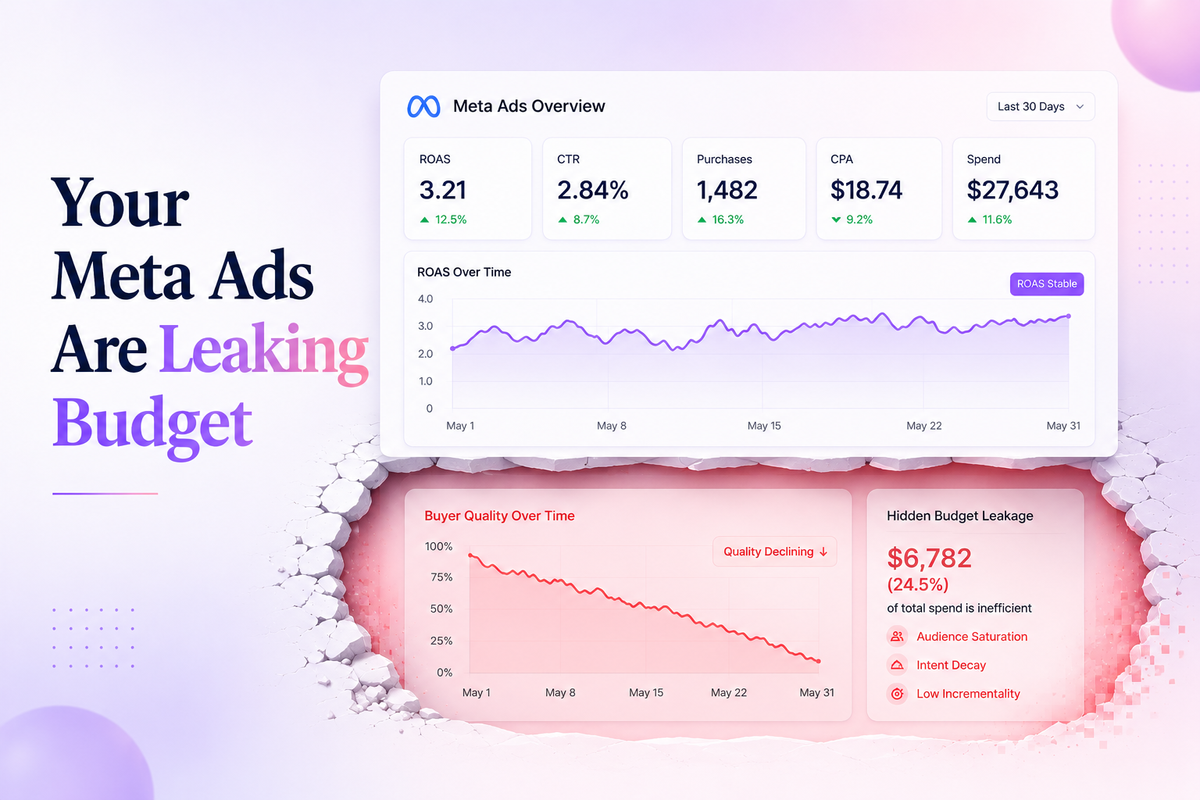
The Budget Leak Most Dashboards Will Never Show You
Most Meta advertisers don’t lose money because campaigns fail. They lose money because inefficiency compounds silently — while dashboards still look healthy.
That's the pattern our AI has repeatedly detected across real Meta ad accounts: audience saturation, hidden CPA inflation, low-intent conversion expansion, and behavioral decay — all invisible inside Ads Manager — accounting for up to 44% of total ad spend.
If you're running AI-powered ad campaigns or managing Meta budgets at scale, here's what the algorithm will never tell you — and why your ROAS number may be quietly lying to you.
Performance Marketing Has Confused Activity With Efficiency
A large percentage of Meta advertisers aren't scaling efficiently. They're scaling acceptable-looking inefficiency — and that distinction has massive consequences for margins and long-term growth.
The industry became addicted to visible, lagging metrics: ROAS, CTR, CPM, CPA. These numbers rarely expose what's actually happening underneath:
- Deteriorating traffic quality as audiences exhaust
- Audience fatigue on Meta ads accumulating below the surface
- Declining buyer intent masked by stable conversion volume
- Margin compression invisible in aggregate reporting
By the time CPM spikes, CTR drops, or conversions slow, Meta has often already spent days or weeks recycling impressions into weaker-intent inventory. Budget leakage doesn't announce itself. It compounds — silently, efficiently, expensively.
3 Early Signals of Hidden Budget Leakage
- Frequency rising while engagement depth declines
- Stable CTR but weaker post-click session quality
- Increasing conversion volume with declining downstream buyer quality
The Algorithm Is Not Your Growth Partner
Meta's algorithm is extremely good at delivery optimization, engagement prediction, and conversion probability. It is not designed to protect your margins, customer quality, or retention economics. That responsibility has always been the media buyer's job — and many have quietly outsourced it to automation.
"A surprising number of media buyers no longer optimize campaigns. They supervise automation."
Broad targeting often performs well initially. At scale, Meta progressively expands into weaker-intent inventory — audiences that still convert just enough to hide the deterioration. This creates false confidence, inflated spend, and hidden inefficiency accumulation that's very expensive to unwind.
This is where behavioral performance intelligence becomes the critical edge. Not another dashboard. Not another Meta ads automation layer. A diagnostic system that exposes what Meta cannot see inside its own ecosystem.
Case Study: The Scaling Efficiency Collapse Curve
One of the clearest patterns our AI uncovered is how profitability efficiency behaves as daily ad spend increases. The chart below maps this across spend levels from Rs.0 to Rs.50K+ per day:
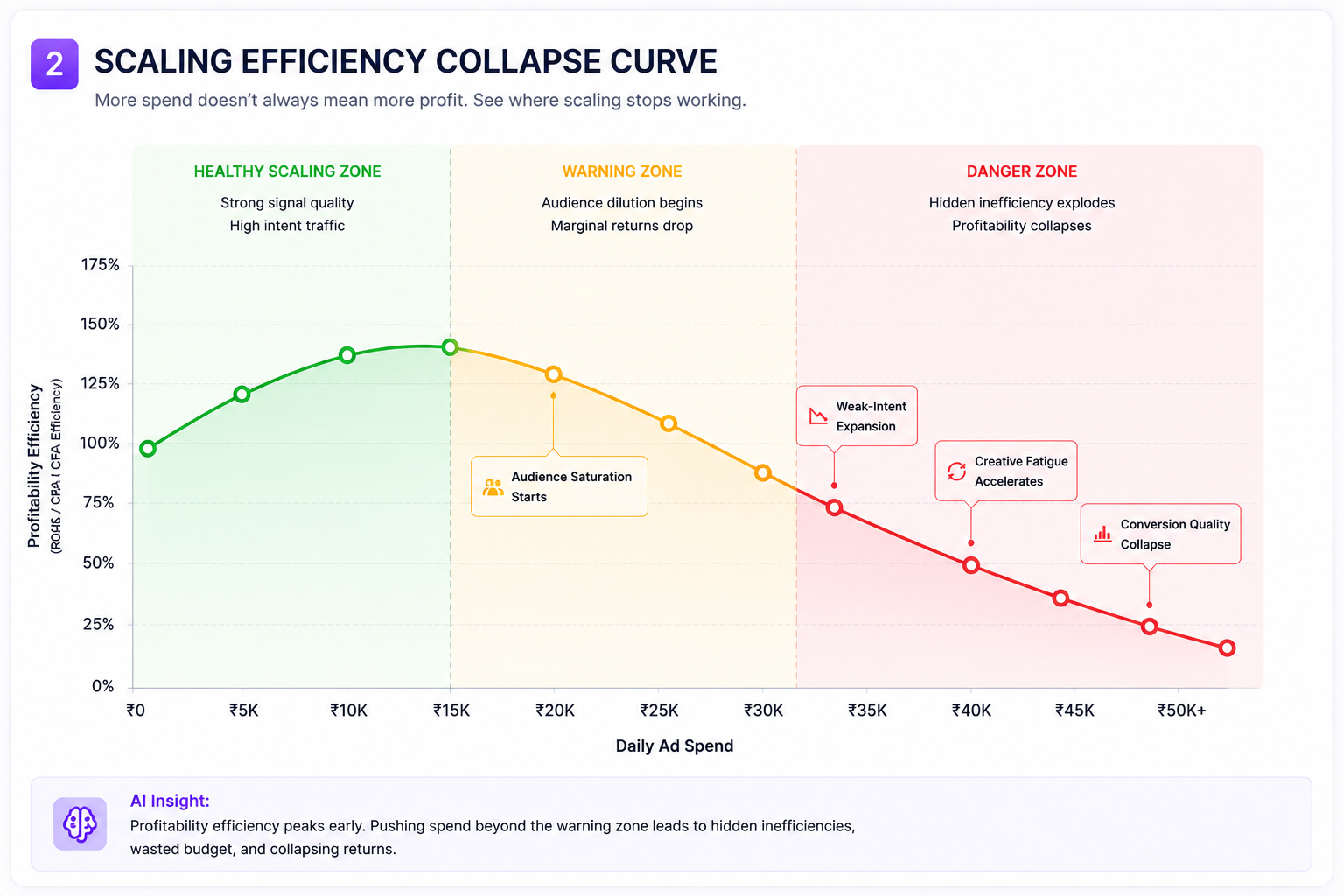
Figure 1: Scaling Efficiency Collapse Curve — Profitability Efficiency vs Daily Ad Spend
The data reveals three distinct phases that most advertisers never consciously map:
What Our AI Actually Detected Inside 'Healthy' Campaigns
The most dangerous Meta campaigns are the ones that look fine. Here are the four behavioral patterns our AI flagged most consistently — across accounts with ostensibly solid metrics.
Pattern 1 — Audience Saturation Arrives Earlier Than You Think
Most accounts hit psychological audience exhaustion before visible metric deterioration appears. By the time advertisers react, Meta has already expanded aggressively into lower-intent inventory. The intervention window is narrow — and it closes silently.
Pattern 2 — Hidden CPA Inflation
Cheap conversions gradually become weaker buyers: lower LTV customers, lower-intent leads, higher churn. The dashboard still reports efficiency. The business experiences declining economics. This is what we call hidden CPA inflation — and it's the most expensive form of Meta ad budget waste.
Pattern 3 — Creative Fatigue Starts Behaviorally
Most media buyers wait for falling CTR or rising CPMs to signal creative fatigue. But fatigue typically begins much earlier — through weaker engagement depth, shorter attention duration, and repetitive audience interaction patterns. By the time metrics shift, the damage is already compounding.
Pattern 4 — Scaling Often Reduces Signal Quality
As spend increases, audience precision weakens, intent quality dilutes, and conversion variance increases. Many advertisers mistake spend expansion for optimization success. In reality, they're buying their way into lower-quality inventory while ROAS holds steady — the classic Meta ads scaling problem.
Case Study: Hidden Spend Leakage Over Time
The following 30-day chart shows what happens inside a campaign when ROAS looks stable but behavioral intelligence tells a very different story:
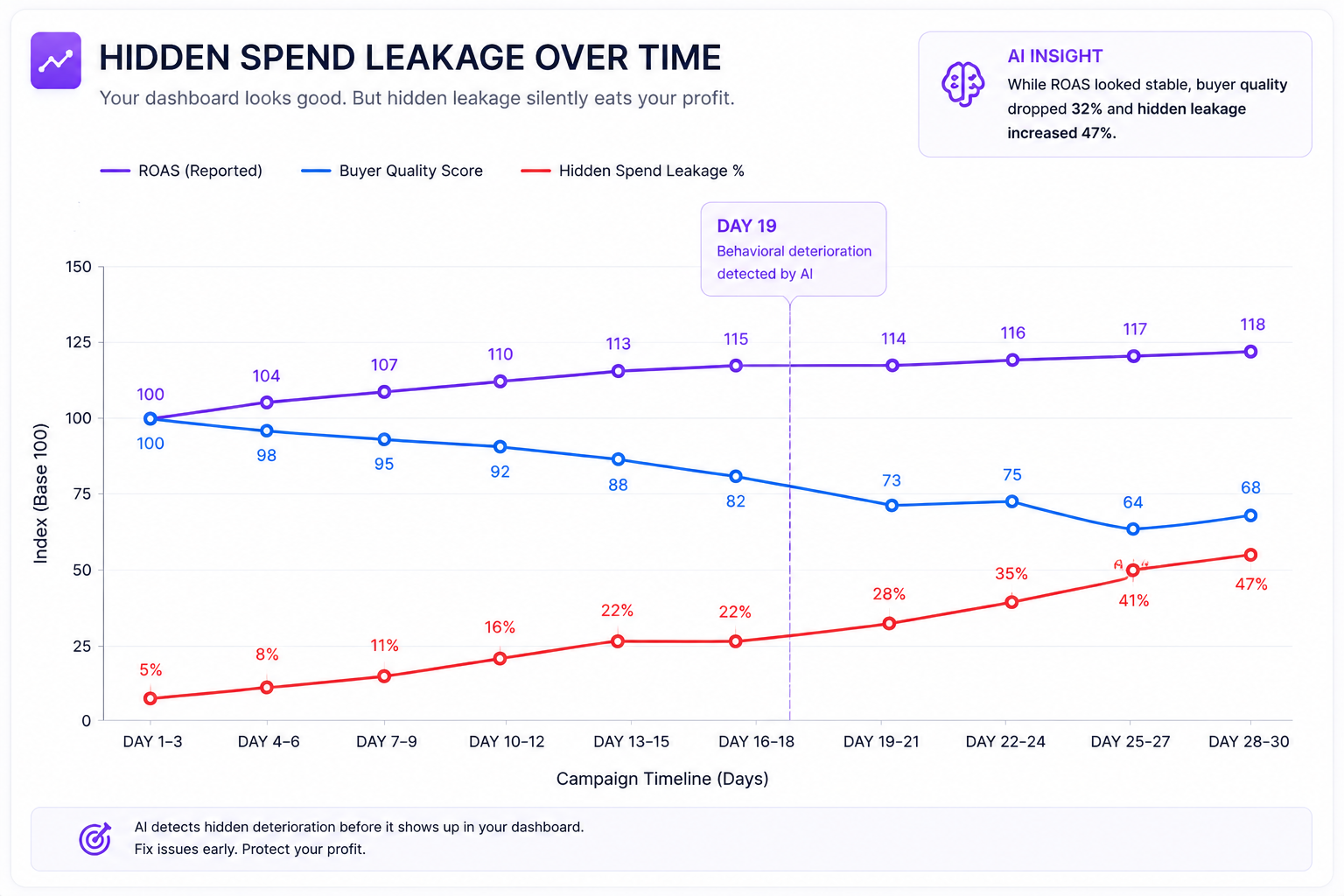
Figure 2: Hidden Spend Leakage Over Time — ROAS vs Buyer Quality Score vs Hidden Spend Leakage %
The three lines tell the story clearly. ROAS (purple) climbed steadily from index 100 to 118 over 30 days — by every standard dashboard metric, the campaign was succeeding. But simultaneously:
- Buyer Quality Score (blue) collapsed from 100 to 68 — a 32% decline in actual customer value
- Hidden Spend Leakage (red) grew from 5% on Day 1–3 to 47% by Day 28–30
- On Day 19, behavioral deterioration was flagged by the AI — before any dashboard metric showed concern
This is the gap between Meta ads automation and true diagnostic intelligence. The platform optimizes for delivery and conversion probability. It cannot measure whether the customers it's acquiring are actually worth acquiring.
The Future of Performance Marketing Is Diagnostic Intelligence
The industry is rapidly commoditizing AI creatives, bidding automation, campaign setup, and targeting systems. Those are no longer durable competitive advantages. Access is table stakes.
The next edge belongs to advertisers who understand behavioral intent, engagement depth, hesitation patterns, buying psychology, and audience deterioration — before spend has compounded into waste. As one way to frame it: “Most ad accounts are rich in data but poor in intelligence.”
This is what separates an AI campaign manager built on behavioral intelligence from a standard Meta ads automation platform. One executes faster. The other sees further — detecting deterioration before it becomes a budget crisis.
Behavioral systems improve over time because they accumulate first-party engagement patterns, customer interaction signals, and conversion behavior insights. This creates compounding intelligence — and real switching costs. It's the difference between running Meta ads on autopilot and actually understanding what's working at a signal level.
Frequently Asked Questions
Why are my Meta ads wasting money?
Meta ads wasting money refers to ad spend going toward low-intent audiences that are unlikely to convert. Most businesses lose budget due to poor targeting, audience fatigue, weak creatives, and missing follow-up systems.
Common reasons:
Low-quality audience targeting
Creative fatigue and declining engagement
Poor retargeting setup
No lead qualification process
According to industry research, nearly 40–45% of digital ad spend is wasted due to poor optimization.
Why does ROAS stay stable while profits drop?
ROAS staying stable while profits drop refers to campaigns generating revenue without improving actual profitability. A Meta campaign can show healthy ROAS while customer quality, margins, or repeat purchases decline.
Why this happens:
Lower-quality customers convert
Profit margins shrink
Refunds or churn increase
Customer lifetime value drops
Studies show ROAS alone does not accurately measure business profitability.
What is hidden CPA inflation in Meta ads?
Hidden CPA inflation in Meta ads refers to a situation where customer quality declines while reported CPA stays stable. Your Meta campaign may still generate conversions, but those leads often have lower buying intent.
Signs of hidden CPA inflation:
More low-intent leads
Lower conversion quality
Reduced customer lifetime value
Higher churn rates
This issue often causes profits to decline even when dashboards look healthy.
How do you detect audience fatigue in Meta ads?
Audience fatigue in Meta ads refers to declining engagement when the same audience repeatedly sees your ads. AI tools detect fatigue before performance visibly drops.
Common signs:
Rising ad frequency
Falling CTR
Higher CPM
Lower engagement rates
AI monitoring can identify fatigue 5–10 days before major performance decline, helping reduce wasted spend.
Can an AI campaign manager reduce Meta ad budget waste?
An AI campaign manager reducing Meta ad budget waste refers to using automation to detect inefficiencies before money is lost. It continuously monitors campaign health and reallocates spend automatically.
How AI helps:
Detects audience fatigue
Flags poor-performing ads
Optimizes budget allocation
Improves lead quality
Studies suggest AI-driven optimization can improve marketing efficiency by 20–40%.
Key Takeaways
Conclusion: The New Competitive Edge Is Diagnostic Speed
Meta’s algorithm is already better at campaign execution than most humans. That gap will only widen. Which means the next competitive advantage is no longer setup, creative iteration, or bidding speed.
It's seeing deterioration before wasted spend compounds. It's detecting what behavioral signals reveal before dashboards react. The Scaling Efficiency Collapse Curve and the 30-day Spend Leakage chart above both point to the same conclusion: by the time standard metrics sound the alarm, the budget damage is already significant.
The marketers who win over the next five years will not be the best button-clickers. They’ll be the fastest at identifying hidden inefficiency — and acting on behavioral intelligence while everyone else is still watching ROAS hold steady.